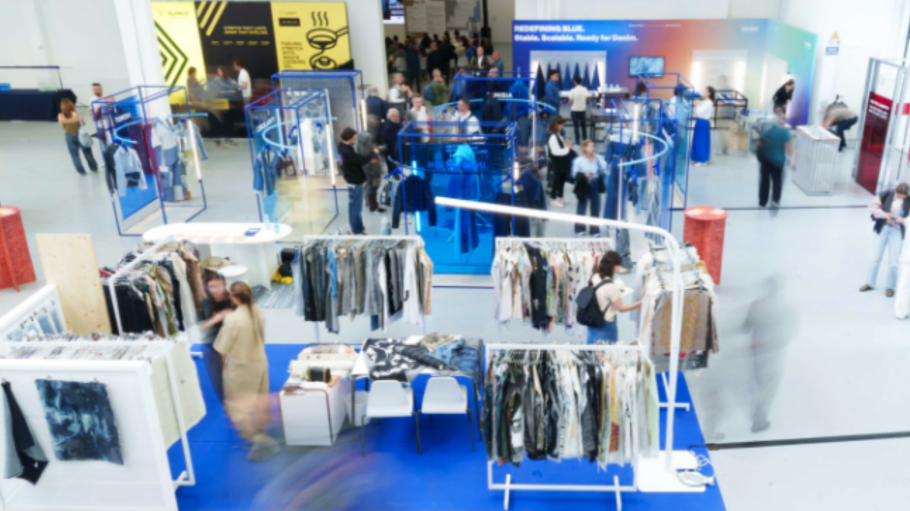
Designers shared their next steps last week at Denim Première Vision in Milan.
Triarchy
Los Angeles-based sustainable brand Triarchy is betting on Lab Denim to help color a more efficient future. Co-founder and creative director Adam Taubenfligel said Triarchy will use the biotechnology firm’s bio-based, indigo-free, post-weave colorization process to create a full collection for Fall 2026.
“For anyone who doesn’t know what that means, it’s basically molecular dye technology that can print a pair of jeans on demand, foregoing the wash process entirely,” he said.
Related Stories
Taubenfligel argued that many sustainable washing techniques are built on systems that were never designed to be sustainable in the first place and still require some resources. In comparison, digital dyeing produces finished pieces (on untreated white denim) without bleaching, stone washing or other conventional finishing techniques.
“It is completely revolutionary, and I think it’s the future of this industry,” Taubenfligel said.
As a small brand, the technology allows Triarchy to produce exactly the amount that is needed, and in a fraction of the time it would take to produce a conventionally dyed and washed garment. Taubenfligel pointed out that it took just 30 minutes to produce Triarchy’s first sample set. And from a sustainability standpoint, he said it solves the industry’s overproduction problem.
Triarchy’s adoption of Lab Denim’s technology is another example of how the brand follows unconventional directions to produce premium denim. Though it began as a traditional denim brand in 2018, Triarchy has sidestepped industry norms in women’s denim, first by using no stretch fabrics, then by being one of the first brands to use Coreva, the natural rubber stretch technology pioneered by Candiani Denim.
While Lab Denim’s technology allows the brand to eliminate laundry costs, the front-end digital design process is time consuming and “adds quite a bit of cost,” Taubenfligel said. However, the brand has found a tradeoff. No matter what the digital design is, all are the exact same price. “This allows us to maintain price consistency across the whole line, regardless of whether the wash looks like it costs a million dollars [because of its vintage look] or whether it’s a basic,” he said.
Botter
Rushemy Botter and Lisi Herrebrugh, the creative directors of G-Star Raw and the founders of Botter, plan to take a more democratic approach to the Botter brand when they relaunch it this fall.
“We feel like it’s the right time to come back, because we think the industry is getting a little boring,” Botter said during a panel discussion at Denim Première Vision. “We have a lot to say and a lot of ideas.”
Seasonless concepts, genderless fits and extended size ranges are part of the designers’ democratic vision. Denim will be a key pillar of the brand in its new form. “Denim naturally came into the conversation because it’s versatile [and so] embedded in everyday culture. And at the same time, it can be so innovative,” Herrebrugh said. “There’s so many things to explore.”
Entry price points for the new Botter brand will be under 100 euros. Prices will max out around 500 euros for outerwear. While the Dutch-Caribbean design duo said their focus will be selling Botter through direct-to-consumer channels, they still believe in physical experiences. “We’re really drawn to working with key retailers to create a different kind of experience,” she said, adding that retail needs to be a marriage between physical and online.
Botter launched in 2017, diving feet first into the luxury tier. However, instead of creating commercial collections sprinkled with a few expensive showpieces for store windows and runway shows, Botter said they ran into the habit of creating almost entire collections of showpieces. Their tendency for selecting innovative fabrics and producing low quantities meant most consumers were priced out of wearing their designs—a mindset that Herrebrugh and Botter said was born from their formal training and has evolved with more experience.
The fast pace of the luxury category caught up to them during the pandemic, when Herrebrugh said it became unsustainable to churn out one collection after another. In 2024, the designers paused the Botter brand to explore other areas of inspiration. “We found the freedom and space to explore ourselves through different channels. We allowed ourselves to think for other brands,” she said.
In 2025, Botter and Herrebrugh were named creative directors for G-Star Raw, starting a new chapter for the Amsterdam-based denim brand and reintroducing Raw Research, the brand’s platform for experimental design.
“To see your designs on the street, and to be proud of how people want to buy something [from the] world you create—that feels so much more democratic and luxurious,” Herrebrugh said.