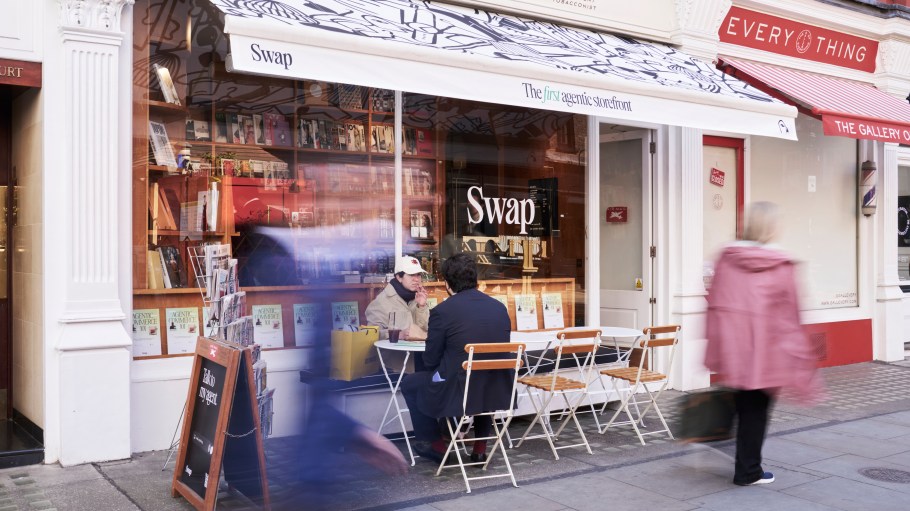
This week, retail’s AI-powered transformation continues with heavy tech investments and new platform launches. Leading the charge is retail intelligence platform Radar, which recently achieved a $1 billion “unicorn status” following a $170 million funding round aimed at scaling its automated inventory tracking across global markets. Diving deeper into agentic commerce is news from Swap, which announced a new interactive “Brand in Residency” storefront collaboration with Air Mail in London and New York. This follows news from Marqo, which rolled out Sibbi, a unified commerce agent built to manage everything from product discovery to checkout in a single conversational thread.
Related Stories
Radar Gets Big Funding Round
Radar, an AI-powered retail intelligence platform, said it has officially achieved “unicorn status” after raising $170 million in a Series B funding round, thereby propelling the company’s valuation to $1 billion.
Co-led by Gideon Strategic Partners and Nimble Partners (with participation from Align Ventures), the capital influx is earmarked to accelerate store deployments, advance next-generation sensor hardware, expand AI analytics capabilities and fuel international growth across Canada, EMEA and Latin America, the company said in a statement today. In tandem with this financial milestone, the company has appointed Abi Viswanathan, a former financial executive at Nuro and Uber, as its new chief financial officer to help steer the company through its next phase of rapid scaling.
The company’s core mission is to bridge the data gap between e-commerce and physical retail, a sector that still accounts for 80 percent of global commerce but has historically operated without real-time inventory precision. Radar’s proprietary platform combines overhead ceiling sensors, software and an analytics layer into a single end-to-end system that tracks tagged items continuously across sales floors, stockrooms and fitting rooms.
By processing more than 100 billion item-level events per day, the company said the technology replaces slow, manual tracking methods with an automated system that captures a full inventory snapshot every eight seconds, delivering 99 percent item-level inventory accuracy.
This continuous visibility transforms daily store operations by feeding raw location signals directly into automated replenishment alerts, omnichannel fulfillment routing, loss prevention triggers and merchandising intelligence. For retailers, this means shelves are restocked before they run empty, online orders are fulfilled with greater accuracy, and store associates can spend less time tracking down products and more time serving customers.
But that’s not all. The massive dataset generated by the platform allows retailers and brands to forecast demand, optimize product assortments and analyze physical consumer behavior in ways that were previously only possible through online shopping metrics.
Radar’s technology is currently deployed across more than 1,400 stores with major U.S. retailers, including Old Navy and American Eagle Outfitters. Company leadership and investors emphasize that operating physical retail without real-time intelligence in 2026 is equivalent to leaving billions of dollars on the table. By eliminating the blind spots of the physical shopping world, Radar said it is successfully establishing a foundational layer of real-time data that not only provides measurable return on investment for major brands today but also sets the stage for future innovations like autonomous checkout.
Swap and Air Mail Collaboration
Swap said it is debuting its first agentic storefront via a multi-city “Brand in Residency” at Air Mail’s retail newsstands in London and New York. “The residency marks the public unveiling of Swap Storefront, a new category of e-commerce experience where AI-powered storefronts guide shoppers from discovery to checkout through one seamless conversation—a platform helping brands transform traditional merchant sites into conversational shopping experiences that convert at twice the industry rate,” the company said in a statement.
The residency turns Air Mail’s retail spaces into an “immersive expression” of the Swap Storefront. This includes featuring branded installations, editorial takeaways, curated merchandise and what Swap describes as “café moments.” There are also branded events planned.
Sam Atkinson, co-founder and chief executive officer of Swap, said the company launched the first agentic storefront “at a moment when commerce is moving from static browsing to guided interaction, creating a new model for how shoppers discover, decide and convert.”
“We’re excited to celebrate the launch with Air Mail,” Atkinson said. “Rather than introducing a product through a traditional software launch, Swap is introducing a category through culture—showing the future storefront is not another widget or chatbot, but an interface designed to improve conversion while keeping brands in control.”
The company said the residency is anchored by Swap’s “Talk to My Agent” campaign, which keys into the idea of speaking directly to a brand’s AI agent.
Liz Gough, chief revenue officer of Air Mail, said the company is “always looking for ways to bring unexpected, culturally relevant experiences to our audience, and this residency does exactly that. Our newsstands are a place for discovery, and we’re delighted to welcome Swap into that tradition and give our community a first look at what they’re building.”
The London residency took place at Shreeji Newsagents last week, during the Pulse e-commerce summit. The New York residency is taking place at the Air Mail Newsstand, located at 546 Hudson Street, through May 24.
Creating Greater Personalization
Marqo said it has introduced Sibbi, which is a unified commerce agent designed to manage the entire shopper journey in a single conversational thread. The company said it is built for retailers who are looking to eliminate the fragmentation between search, checkout and customer service. Sibbi lets shoppers describe products in natural language, upload photos for visual search, receive personalized recommendations, complete purchases and then handle order tracking or returns without switching channels.
Marqo CEO Tom Hamer said in a statement that the future of commerce “belongs to brands that own discovery…We built Sibbi to fix that: a dedicated intelligence that understands every product in your catalog and the nuance of every customer interaction.”
By maintaining context across interactions and transforming logistics into new discovery moments, the company said Sibbi aims to close the costly gap between acquisition and retention.
Sibbi is powered by Marqo’s “Commerce Superintelligence,” which is an AI layer that is trained uniquely for each retailer. Sibbi combines deep product understanding with behavioral data to create continuous personalization. Marqo CTO Jesse Clark said a model‑first philosophy is behind the technology. “You don’t deliver better customer experiences by layering AI on top,” Clark said. “You get there by building at the model layer.”
For retailers and investors, Sibbi signals a shift toward agentic commerce, where discovery, service and revenue continuity operate through one intelligent system rather than a patchwork of disconnected tools.