As workforces navigate feeling both empowered and intimidated by the rise of AI, the onus is on leaders to equip their teams to forge the new era of work.
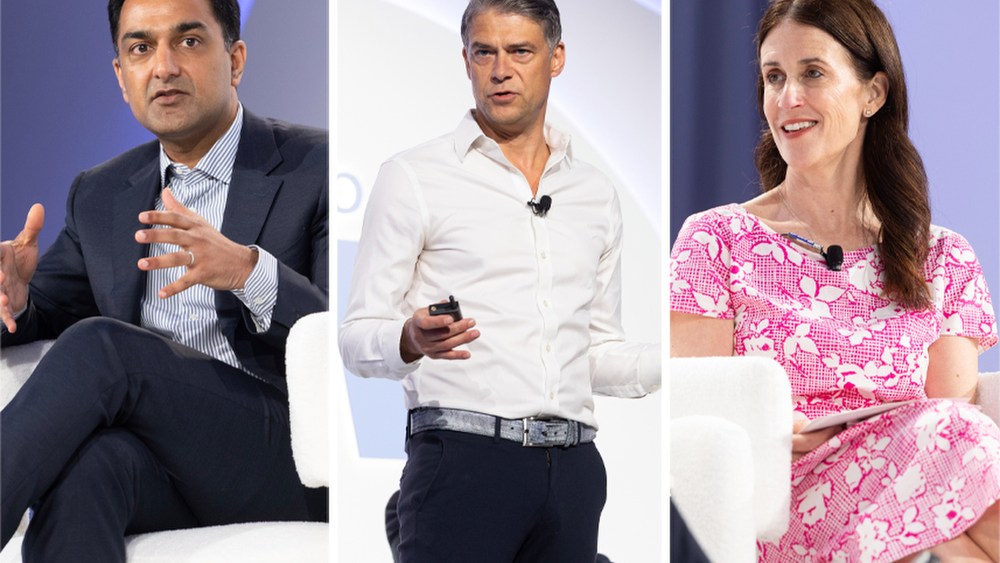
“We’ve been through the digital, social and mobile revolutions — this change is more profound. It is also harder. It requires a lot of people change and culture change and workflow change,” said Revlon chief executive officer Michelle Peluso, who moderated a panel with CVS Health’s Musab Balbale and Ghd’s Jeroen Temmerman at the 2026 WWD Beauty CEO Summit.
Related Articles

For Balbale, who is senior vice president and chief merchant at CVS, one of the biggest learnings of the last two years has been not to view AI solely as a tool to drive better outputs, but rather, “a tool that allows us to do everything differently. We’re all chasing ROI, but the measurements and KPIs around how we work are equally important as the financial KPIs,” he said.
One of CVS’ biggest goals is to use the technology to improve localization across its 8,500 stores, each of which serve distinct, nuanced communities.
“We’re trying to get to a place where every product in every store is very intentional,” said Balbale, adding that in addition to using AI to strategize store planograms, CVS has implemented occasional two-week “sprints” where teams work hard and fast to figure out how to use AI to streamline their most cumbersome tasks.
“People get overwhelmed by the size of the opportunity and the complexity of the tools, so [this]…gets everyone, from top to bottom, engaged in the process,” he continued.
Temmerman, who is CEO of the 25-year-old hair tools brand Ghd, said that with AI, “business fundamentals will still be the same in 10 years time, but how they are executed will be extremely different.”
When the Ghd team recently used AI to create a six-question Curl Finder online quiz to help DTC consumers — who make up 30 percent of the business — find the right curler for them, a few key learnings emerged.
“[The AI] entered the world of hallucination. We had to execute more than 2,000 human interventions in the end to get this Curl Finder online, so we learned human intervention is still very necessary when you drive artificial intelligence projects,” Temmerman said.
In addition, Ghd quickly realized it needed to clearly state that the quiz and its imagery were AI-generated, in order to maintain consumer trust that the rest of the company’s imagery is not.
“Consumers started to challenge other parts of our website — [asking] is this hair real? Are your models real?…so the Finder was labeled as ‘powered by AI’ and in that way we’re clear about which of our content is real, and which is there to improve a customer experience.”
Balbale’s team, too, has had to reckon with where it can and can’t utilize AI in order to uphold CVS’ values.
“How copy shows up, how we describe products, languages we use — all those things are accelerated and made more personalized using AI. For us at CVS, the physical image of a person, though, is a bright line we’re choosing not to cross,” he said.
Accelerating workers’ ability to harness AI, on the other hand, is a top priority.
“The biggest opportunity we have as leaders is to make our teams as capable as possible to succeed in a future of AI, and that means getting them off the work that will be replaced by AI, while simultaneously teaching them how to use these tools or find new areas to drive revenue or margin for the business,” he said.