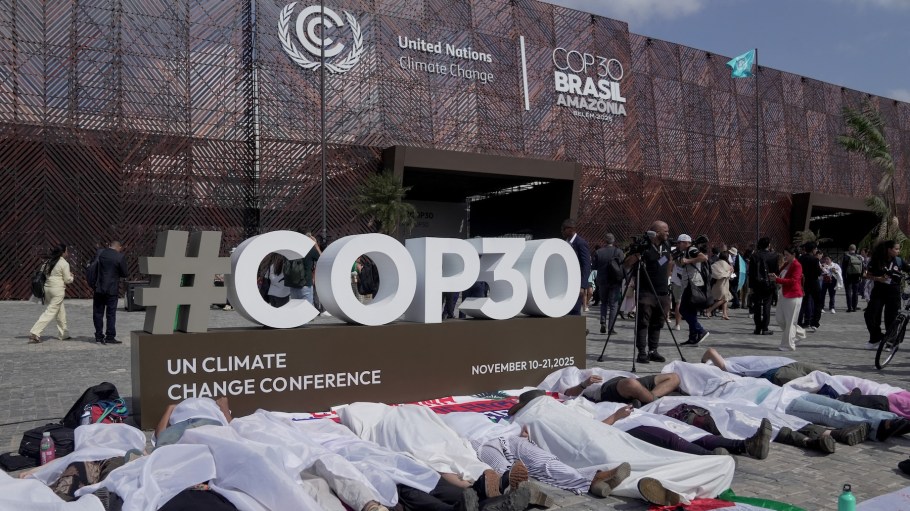
As the 30th Conference of the Parties to the United Nations Framework Convention on Climate Change—informally known as COP30—rolled through Belém, Brazil, fashion’s climate talk came crashing into its emissions reality—one where a UN-backed roster of industry heavyweights urged world leaders to fast-track a clean energy transition.
Supply chain emissions jumped 7.5 percent in 2023, per the Apparel Impact Institute. Only 7 percent of major brands report their renewable energy use, per Fashion Revolution’s “What Fuels Fashion” report. McKinsey, meanwhile, warned that without major shifts, the sector’s emissions could swell from about 2 billion metric tons in 2018 to 2.7 billion by 2030.
Related Stories

On the fossil fuel front, its phase-out roadmap continued to grow in the heart of the Amazon rainforest, with more than 80 countries—across Africa, Asia, Latin America, the Pacific and Europe—already onboard, according to the Global Gas & Oil Network (GGON). Comprising more than 300 non-governmental organizations from 60 countries, GGON “works to facilitate a global managed decline of oil and gas production,” per the network.
These countries joined a group of supporters calling on the summit’s Brazilian leaders to “integrate a more ambitious phase-out outcome” at the next opportunity for collective mobilization—what the COP30 presidency has referred to as the mutirão, adopting the Portuguese term to “encourage engagement and action,” according to market intelligence provider Argus Media.
The Under2 Coalition—another global network, committed to achieving net-zero emissions by 2050—had the same request; what GGON said “reinforces the momentum for a roadmap from subnational governments.”
The appeal was made moot when the final COP30 agreement didn’t include a fossil fuel phase-out—instead, the presidency created separate roadmaps, outside the COP negotiation process, to address fossil fuels and deforestation. Progress is expected to be reported at the next summit (or mutirão).
At the same time, operational artificial intelligence emerged as a recurring topic across the summit’s side events and technical sessions as discussions focused on its carbon footprint and role in modeling climate risks. However, operational AI for buildings remained absent from climate strategies. Exergio, a Lithuanian-based company developing tools for energy efficiency in real estate, saw this as a blind spot that emerged during phase-out negotiations: Using AI in buildings holds “immense potential” to cut energy waste with haste.
“AI is constantly framed as a new burden. What’s interesting is that the same machine-learning methods that drive energy use in data centers can cut emissions at the point where most electricity is actually consumed, in buildings,” said Donatas Karčiauskas, CEO of Exergio. He warned that it happens—despite scientific and real-world proof—that AI doesn’t only waste, but can actually reduce energy use in specific sectors, such as the building industry.
“We don’t have to choose between AI growth and climate goals,” Karčiauskas said. “If we apply AI where emissions are actually generated, the climate will win.”
While the summit wrapped up without binding fossil fuel cuts and AI left out in the cold, EcoVadis found that U.S. companies are already facing a complex sustainability challenge. The provider of global business sustainability ratings said climate inaction is mounting; ignoring supply chain emissions could cost companies more than $500 billion annually by 2030, according to the 2025 Carbon Action Report by EcoVadis and Boston Consulting Group (BCG).
“The financial risks of climate inaction are clear, but so are the opportunities,” said Pierre-François Thaler, co-founder and co-CEO of EcoVadis. “By addressing Scope 3 emissions, companies can protect profitability while building a more resilient supply chain. The time to act is now, and the most effective place to start is with suppliers, where the majority of emissions lie.”
To that end, new modeling data suggests that significant Scope 3 emissions can be reduced by engaging a relatively small number of key suppliers.
That’s according to Reset Carbon, a Hong Kong-based emissions reduction consultancy acquired by LRQA, a global risk management partner, in January. Indirect emissions created across the supply chain—otherwise known as Scope 3 emissions under the Greenhouse Gas Protocol (GHG Protocol) Corporate Standard—typically account for more than 80 percent of a company’s total carbon footprint, per the consultancy.
“Supply chains are becoming increasingly exposed to carbon pricing via the incoming EU Carbon Border Adjustment Mechanism or exporter country emissions trading or carbon taxes,” said Liam Salter, CEO of Reset Carbon, before referencing BloombergNEF research on carbon prices under the EU Emissions Trading System expected to rise to €140 pounds ($185) per metric ton by 2030.
Reset Carbon’s modeling shows that targeting key suppliers can help organizations accelerate impact. Across other manufacturing and retail supply chains, the company’s analysis found that initial cuts of 15-30 percent can be achieved, and quickly at that, through collaboration on existing and proven technologies. Looking ahead, larger cuts of 40-60 percent are possible in the longer term through energy or fuel switching.
“If businesses want to avoid long-term carbon cost risks, they need to act now,” Salter said. “Supply chain emissions take time to reduce—we’re talking three years or more to see meaningful results.”
While many companies have already gathered supplier emissions data, the next challenge risks getting lost in translation: turning the data into delivery plans. Integrating emissions targets into sourcing decisions confirms that carbon performance can become a part of standard commercial strategy, per Reset, not a parallel effort.
“There’s often a misconception that carbon reduction means high cost,” said Salter. “In reality, many reductions can be delivered through measures like efficiency and onsite renewables, with strong returns on investment.”
For Reset, strategic suppliers represent a “major lever” for net zero progress. Going beyond individual supplier relationships, cross-industry collaboration is emerging as an enabler of supply chain decarbonization, too.
“As suppliers serve multiple brands, coordinated approaches reduce duplication and create stronger incentives to invest,” Salter said.
On that note, the Global Circularity Protocol for Business (GCP) initiative—one that brands such as Apple, Nike and Google have committed to—debuted during COP30. Unveiled Nov. 11 by the World Business Council for Sustainable Development (WBCSD) and the One Planet Network (and hosted by UNEP), the GCP establishes a “unified, science-based foundation to accelerate business transformation worldwide.”
And Tomra, for one, has taken a “leading role in driving global circularity” as a GCP “business champion.”
“The GCP represents a significant step forward in aligning businesses around measurable, scalable circularity action,” said Tove Andersen, president and CEO of Tomra. “By creating a shared framework for progress, the GCP will accelerate the shift from intention to impact—driving systemic change and informing policies that advance a circular economy.”
The first globally harmonized voluntary framework of its kind was developed with over 150 experts from 80-plus organizations. It aligns with global standards and enables credible, comparable reporting to support international companies in meeting rising regulatory requirements and stakeholder expectations.
WBCSD president and CEO Peter Bakker noted that the framework sets a new benchmark for corporate performance and accountability.
“The GCP packs a serious punch,” Bakker said. He referenced an impact analysis revealing that the GCP could enable 100–120 billion metric tons of cumulative material savings by 2050—per Bakker, the equivalent to one year’s current global material consumption.
“And let’s not overlook the potential for accelerated emissions reduction,” he said. “Adoption of the GCP could deliver 67–76 gigatons of CO₂ equivalent avoided by 2050, or about 1.3–1.5 times current annual global emissions.”
Global sugarcane platform Bonsucro, meanwhile, announced its partnership with the Alliance of Bioversity International and the International Center for Tropical Agriculture (CIAT). Together, the organizations will advance the latter’s Climate Resilience Platform (CRP) to extend its scope to sugarcane producers, across Latin America, Southern Africa, Southern Asia and Southeast Asia, as well as cotton growers in India and Brazil.
“Climate resilience is critical for producers in regions facing increasingly unpredictable weather and market conditions,” said Mike Ogg, regional manager for Africa and the Middle East of Bonsucro. “By joining the CRP, Bonsucro will help more producers harness the latest scientific insights and practical tools to plan and protect livelihoods.”
The collaboration was delivered in partnership with Better Cotton as part of Bonsucro’s Climate Action Toolkit—an initiative for sugarcane producers to understand, as to mitigate, climate risks. It’s funded by the ISEAL Innovations Fund and the Bonsucro Impact Fund (BIF), developed with Better Cotton, among other partners.
“We are proud to partner with Bonsucro by bringing the benefits of the Climate Action Toolkit to cotton producers,” said Klara Shepherd, senior climate impact coordinator at the Better Cotton Initiative. “Recognizing the crucial role of adaptation to support farmers in the face of a changing climate, this collaboration exemplifies our commitment to meeting farmer needs and sharing innovation across agricultural sectors.”
On that note, Prince William announced the winners of this year’s Earthshot Prize, an initiative he founded in 2020 to scale environmental solutions, on Nov. 5 at the Museum of Tomorrow in Rio de Janeiro, Brazil.
“When I founded The Earthshot Prize in 2020, we had a 10-year goal; to make this the decade in which we transformed our world for the better,” Prince William said in a statement. “We set out to tackle environmental issues head on and make real, lasting changes that would protect life on Earth.”
The 2025 cohort comprised Amazonian forest restoration firm Re.green for the “protect and restore nature” category, Bangladeshi nonprofit Friendship took home the “fix our climate” category and Amsterdam nonprofit High Seas Alliance was awarded the “revive our oceans” category. Nigeria’s Lagos Fashion Week was recognized within the “build a waste-free world” category, with the Colombian city of Bogotá taking home the “clean our air” category.
“This year’s winners share an approach we support at GFA: solutions that address root causes rather than symptoms,” the nonprofit said in a statement. “From Brazil’s Atlantic Forest to Bogotá’s streets and the high seas to African fashion, these innovators demonstrate that environmental goals and thriving communities can coexist.”
The winners, one for each of the five Earthshot categories, will be awarded one million pounds ($1.31 million) to advance or replicate their work, “in recognition of their achievement and potential.” This year’s cohort was selected from nearly 2,500 nominations across 72 countries—what the Global Fashion Agenda (GFA) called a “testament to the global urgency and ingenuity” driving environmental action.
“There feels a real symmetry in being here in Rio this year; climate has come home,” Christiana Figueres, chair of The Earthshot Prize board of trustees—plus a founding partner of Global Optimism and former climate change chief at the United Nations—said before acknowledging the city’s climate progress that began back in 1992.
“As we build a global legacy, these winners are proof that the spirit of collective action born here in Rio continues to grow stronger, more determined, and more urgent than ever,” she continued. “Their 2030 aims are deeply ambitious—but their impact to date, their plans in place and their tenacity fuels my optimism.”