Incubators and funding rounds are accelerating sustainable innovation, but sustainability remains a grassroots movement. RicRack exemplifies this—transforming waste into opportunity while fostering community, education, and social impact.
The New Orleans-based sewing and textile recycling non-profit is filling a gap in local waste management. Twice a month, the organization accepts clothing and textile donations, which the RicRack team sorts on site. Some pieces are selected to stock RicRack’s resale French Quarter storefront, helping fund its programs, while others are repurposed as materials for sewing classes. Textiles that cannot be reused are sent to a recycler in South Carolina for a small fee paid by the donor.
Related Stories
“About 40 percent of the items that come in go into our reuse store. Another 40 percent are used in sewing classes, and about 20 percent goes to textile recycling, where it’s turned into a secondary material,” said Alison Parker, founder of RicRack.
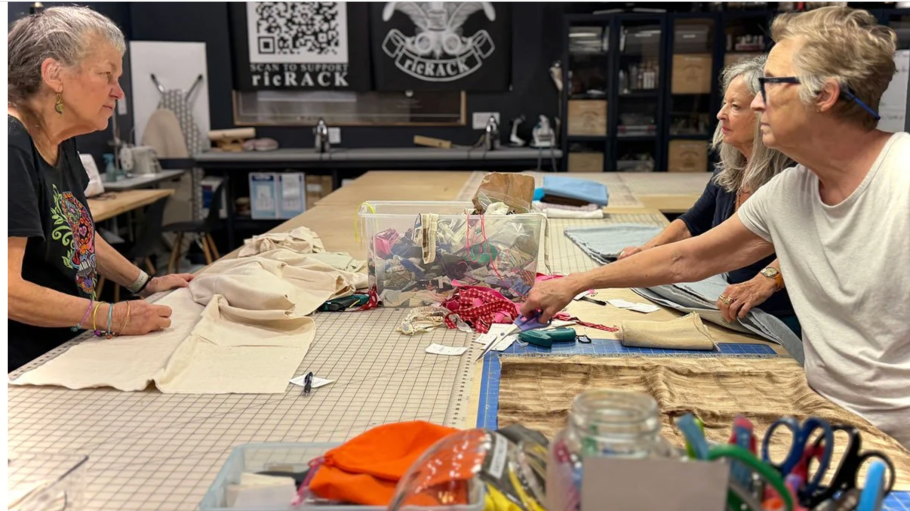
It’s all part of Parker’s mission to foster creative skill-building and raise awareness of waste reduction within the fashion industry. The organization functions both as a textile recycler and a community program offering accessible sewing classes and creative workshops, particularly for youth, where participants learn often overlooked skills like sewing, mending, and upcycling.
Courses span a Saturday morning sewing club for kids ages 8 to 12 to six-session sewing bootcamps to specific courses on denim felting, hand embroidery and kite making. Summer camps take place throughout June and July. Students have access to six home machines, one industrial straight stitch, one industrial walking foot machine, sergers, cutting table and sewing tools.
The idea for RicRack took shape in 2012, when New Orleans still had a thriving film industry. With a background in costume design for film, theater, and live performance, Parker witnessed firsthand the enormous volume of fabric and clothing being used and discarded. Around the same time, “Overdressed: The Shockingly High Cost of Cheap Fashion” by Elizabeth L. Cline came onto her radar, deepening her awareness of the environmental and social impacts of fast fashion.
“I feel like for anybody who works in fabric, if you sit at a sewing machine, especially, you have a responsibility to know that what you’re working with and how it damages the environment if you throw it away, period,” Parker said.
While Parker saw a clear opportunity to promote circular practices, there was a major gap: few places were teaching people how to repair and mend their clothing. “Unless someone had a neighbor or a grandmother to teach them, kids just weren’t learning these skills,” she said.
RicRack grew out of that fusion of ideas. “At the core, I wanted to teach kids how to sew while also encouraging them to think creatively about reuse—asking questions like, “If I can’t wear this anymore, what else could it become?” or “How else can I use it?” Throwing something away should always be the last option. It’s about building those skills while also raising awareness about the impact of textile waste,” Parker said.
RicRack’s initial textile supply came from film productions and a quilting shop that had closed its doors. Word quickly spread, and donations began to grow. With New Orleans’ vibrant costume culture and strong artist community, there was no shortage of fabric, trims, and creative materials to be share—though that early pipeline is shifting, as donations from film productions have begun to decline alongside the rollback of local tax incentives.
Securing funding has become increasingly difficult, particularly as small organizations like RicRack compete for limited resources alongside major cultural institutions—such as PBS—that are also facing significant funding cuts.
The New Orleans Jazz & Heritage Foundation has supported RicRack’s efforts to teach the next generation heritage skills that are going by the wayside. The organization’s events, such as the annual Designer Textile Reuse Challenge—a showcase of local talent held each Earth Day—help raise funds through a silent auction while celebrating creativity and sustainability.
However, it has been more challenging to secure funding for the organization’s efforts to scale circular practices at a local level, which tend to resonate less with traditional funders.
Parker describes the experience in terms that echo challenges seen across the sustainable innovation world: “Sometimes it’s one step forward, two steps back.”
This article was published in SJ’s sustainability report. Click here to read more.