Material World is a weekly roundup of innovations and ideas within the materials sector, covering what’s changing in how fashion is made, scaled or engineered from emerging biomaterials and alternative leathers to sustainable substitutes and future-proof fibers.
Kornit Digital

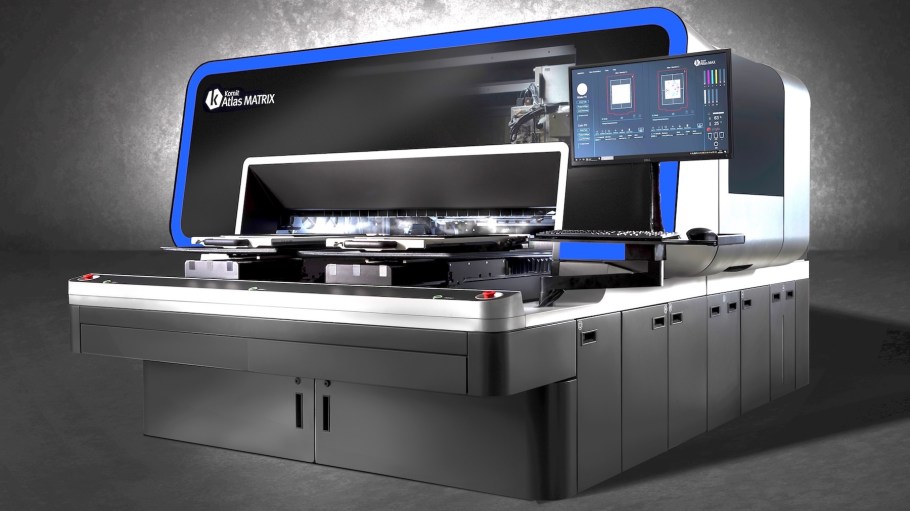
Direct-to-garment and direct-to-fabric printing company Kornit Digital is commercially launching its Atlas Matrix platform following a global beta program. The move expands Kornit’s digital production capabilities into polyester, blended and sublimated fabrics.
Related Stories
Announced ahead of Europe’s exhibition for the print and signage industry, the FESPA 2026 trade show in Barcelona, the system builds on the company’s existing Atlas Max Plus platform. It’s designed to allow manufacturers to move between cotton—as well as polyester and blends—within a single production workflow.
The launch tackles a technical obstacle in digital apparel decoration: dye migration on polyester and sublimated garments. Kornit said the platform uses its proprietary “Karbon Shield” process to enable direct printing on those materials while continuing retail quality output and industrial productivity.
“The apparel industry is rapidly shifting toward agile, on-demand production models that require far greater flexibility, efficiency and responsiveness,” said Ronen Samuel, chief executive officer of Kornit Digital.
The platform has already been tested with production partners across Europe and North America, including print-on-demand and fulfillment providers. Among the beta participants was Spread Group—a global, tech-driven print-on-demand company—which said it has already begun shifting portions of its polyester production onto the platform.
“We are particularly impressed with the possibility of direct printing on dye sublimated shirts,” said Frederik Huhn, director of global fulfillment at Spread Group.
P-Life Japan Inc.
P-Life Japan Inc. said new research conducted with university and industry partners identified microorganisms capable of degrading plastics treated with the company’s additive technology.
“P-Life is a biodegradable additive made from coconut palm oil trees. Just a small dose turns conventional plastics into materials that disappear naturally,” the company said in a statement. “Same production process, same product properties and 100 percent recyclable.”
The Tokyo-based company said the findings stem from collaborative work involving Keio University and ITO EN Ltd., focused on polyethylene and polypropylene materials treated with P-Life’s biodegradable additive. That additive is designed to alter the molecular structure of the conventional plastics, per P-Life, creating lower-molecular-weight compounds that microorganisms can metabolize over time.
P-Life’s testing, conducted under International Organization for Standardization (ISO) 17556 and Japanese Industrial Standard (JIS) K6955 standards, demonstrated biodegradation rates exceeding 80 percent in soil environments during defined analysis periods. The company also cited marine studies that identified bacterial strains associated with degradation activity on treated plastic films.
P-Life positioned the technology as a potential complement to recycling and circularity efforts as brands and regulators face increasing pressure around plastic waste and environmental persistence.