Last week denim retailers published their results for Q1. While the war in the Middle East introduced new challenges for Abercrombie & Fitch, the retailer’s profits exceeded both the company’s and Wall Street’s expectations. Gap Inc. delivered its ninth consecutive quarter of positive comp sale. And American Eagle Outfitters reported mixed results with Aerie offsetting declines at American Eagle.
Here’s a closer look at how denim contributed to these results and what executives are saying about the jeanswear category.
Related Stories
Gap Inc.
Gap’s net sales of $796 million increased 10 percent year-over-year and comparable sales were up 10 percent as the brand continued to demonstrate culturally relevant storytelling in destination categories, including denim, fleece and kids and baby, according to Katrina O’Connell, Gap Inc. executive VP and CFO.
By category, Richard Dickson, Gap Inc. president and CEO, president and director, said denim remained the key driver of growth in Q1. The brand’s focus on delivering trend-right product drove another quarter of market share gains.
“Category performance also remains very healthy and consistent, particularly in denim. We’ve been delivering clear and consistent brand messages, which is obviously resonating with our consumers, particularly with Gen Z. The collaborations that we’ve done continues to drive excitement and cultural relevance. At the same time, I will say we’re maintaining that broad multigenerational appeal,” Dickson said.
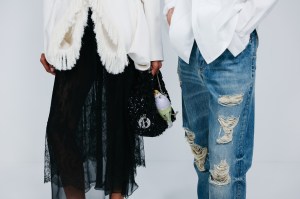
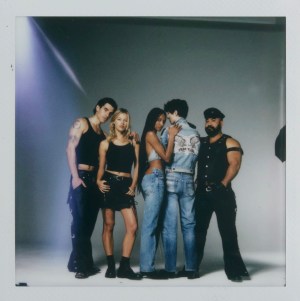
In Q1, the retailer reimagined Gap Classics with product collaborations “shaped by the distinctive creative lens” of Harlem’s Fashion Row (HFR), Awake New York and Victoria Beckham. Product highlights span Gap x HFR overdyed jackets and denim corsets to Gap x Victoria Beckham denim zip shirts and high-rise straight jeans.

The brand also activated at Coachella in April, hosting the Hoody House, which Dickson said sold roughly 10,000 custom hoodies and generating over 300 million social media and press impressions.
“Founded in 1969 as a brand selling denim and records, Gap has always lived at the intersection of fashion, music and culture,” he said, emphasizing how the activation served as “another powerful demonstration of Gap’s cultural influence, authenticity and growing relevance with a new generation of consumers.”
Denim was a key driver in Gap’s turnaround efforts for its kids and baby segment. The category saw a “notable return to growth” in the first quarter, positioning as a destination with collections like My First Denim in baby and trend-right fleece and denim offerings for kids builds resonance, Dickson said.
“As we look ahead into the second half of the year, we have several building blocks in place that give me confidence in our ability to deliver continued improvement. We are seeing strength in denim and active and we expect these key strategic categories to build in prominence in the second half of the year,” Dickson said.
Old Navy’s net sales of $2 billion increased 1 percent year-over-year with comparable sales up 1 percent. Old Navy maintained a top 3 rank in denim and kids and baby and gained share in denim specifically.
With seasonal categories like dresses performing weaker than expected, Old Navy is eagerly looking at the second half of the year. “We’ve got some great exciting new strategic category news with back-to-school programming, our emphasis on active and denim, which are winning categories for us. We’re investing in categories that we believe our customers will respond to,” Dickson said.
Abercrombie & Fitch Co.
Denim continues to play a large part of Abercrombie’s lifestyle brand positioning.
“We are not seeing any change in the demand for denim. We’re actually excited about what we’re seeing. There are some exciting trends happening within denim,” said Fran Horowitz, Abercrombie & Fitch Co. CEO, during the company’s Q1 earnings call.
Robert Ball, the company’s EVP and CFO, added that denim is one of a category that the company is protecting from a price point standpoint. “We’re seeing success in denim across the brands, which is a great place to be, and the bottoms business has been good for us,” he said.
In the Americas and the U.K., Horowitz said Abercrombie saw balanced growth across genders with fleece, denim and wovens performing well. “We continue to find excellent collaboration partners to highlight Abercrombie’s elevated lifestyle brand positioning,” she said.
American Eagle Outfitters
American Eagle’s results were mixed in the quarter. Jay L. Schottenstein, American Eagle Outfitters (AEO) CEO said the company delivered the third consecutive quarter of positive performance in men’s but saw softer trends in women’s bottoms including denim.
“While May started slowly for the AE brand, we are encouraged by the improvement in the business that we have seen over the last few weeks. We remain highly confident in the relevance and resilience of the overall AE brand and in our ability to strengthen execution and drive better results moving forward,” he said.
The brand is actively working to improve the women’s bottom segment and has already seen more positive results, according to Jennifer Foyle, president, executive creative director for American Eagle and Aerie. Though women’s shorts were slow despite a second campaign starring actress Sydney Sweeney supporting the category, Foyle said shorts had “a huge turnaround” during the Memorial Day weekend.
“We know where the problem is. We are going to pivot, and we have already done testing for back to school. We know what rises are working. We know what fits are working,” she said. Foyle added that the company is “excited to enter into our Super Bowl,” or Q3 which is where the brand tends to lead in denim.
“We think we have the right fits and flares for back to school. You are going see more excitement in denim, ranking some fashion silhouettes into our top 10,” she said.