Walmart is consolidating its shipments in the first mile of the supply chain in a move designed to simplify how “prepaid” suppliers ship inventory to U.S. warehouses.
The consolidation will enable the retail giant to move products to shelves faster, cut logistics costs and improve in-stock product availability across its fulfillment network.
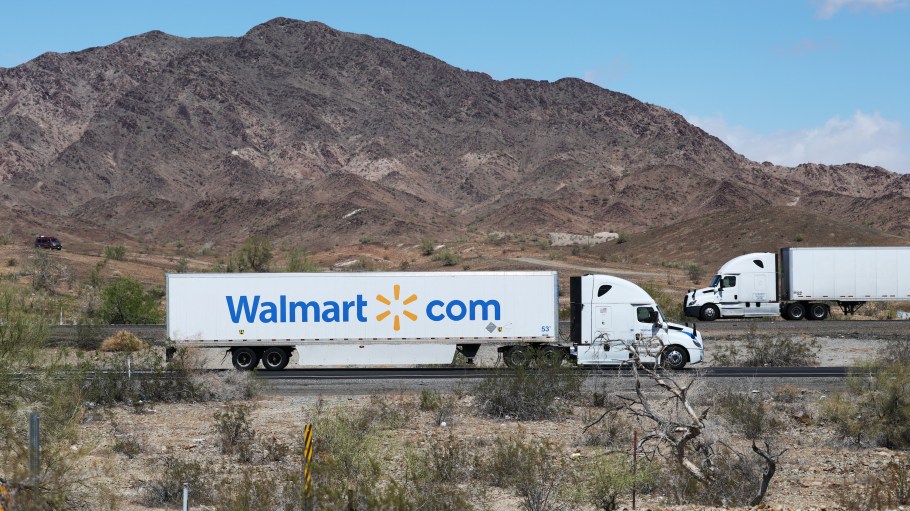
On Tuesday, Walmart introduced the Prepaid Consolidation Program, which enables prepaid suppliers to consolidate smaller orders of separate shipments into one truck at one of its three automated consolidation centers, before shipping the pallet to one of its 42 individual regional distribution centers.
Related Stories
The process is designed to save the costs that would be incurred if the smaller shipments were traveling directly from the origin to the regional warehouses via less-than-truckload (LTL) carriers. Vendors often use LTL carriers when their shipments can only take up part of a truck’s space, rather than the entire semi-trailer. These carriers often have travel longer distances, extending lead times.
With the program, America’s largest retailer is effectively using its national supply chain network to create a more scalable way for these suppliers to merge shipments, ideally improving transportation efficiency without requiring any changes to prepaid freight terms.
Walmart has made it a point in recent years to cut down on supply chain costs, having built out an e-commerce operation that has accomplished a rare feat across online retailing: profitability. Additionally, the company has been focused on getting inventory as close to customers as possible, having recently unveiled it can reach roughly 60 percent of the U.S. population in 30 minutes or fewer.
Before the launch of the program, the automated consolidation centers were only made available to suppliers partnering with Walmart via “collect” inbound freight terms. Under those terms, Walmart has to arrange and pay for its own trucking fleet to pick up goods from the supplier.
Unlike collect suppliers, prepaid suppliers pay for the full transportation route at a price-per-case rate from origin all the way to the regional DC. This includes the labor costs of handling the inbound shipments at the consolidation center. These suppliers tend to have more control over the logistics process, as they get to choose the trucking carrier, set the shipment schedule and manage routing.
Suppliers working with participating providers will access region-specific pricing through Walmart’s published rate card, with no additional markups applied by participating providers to services performed by Walmart, the retailer says.
“We’re focused on making our supply chain simpler, faster and more efficient for suppliers, while also keeping products in stock for our customers,” said Mike Gray, senior vice president of supply chain at Walmart U.S. in a statement. “By strengthening our first-mile capabilities, we’re reducing complexity and keeping goods moving, so we can deliver even more value every day.”
According to the company, the consolidation program will scale in phases, with participation prioritized based on volume alignment and capacity expansion. The shipments are combined at one of three high-tech consolidation center locations: Colton, Calif.; Minooka, Ill.; and Lebanon, Pa.
Suppliers can choose to manage their shipments directly through Walmart or work with one of the program’s three company-approved third-party logistics providers (3PLs), C.H. Robinson, Hub Group and RJW Logistics.
C.H. Robinson outlined other potential benefits of the program, noting that suppliers managing through a single partner will not need to add facilities, interact with multiple providers or take on long-term operation commitments.
The 3PL noted that the consolidation program offers dedicated account management and retail supply chain expertise to suppliers. Additionally, the company indicated that users can adapt to future network changes without having to make major supply chain updates and investments.
“Walmart’s inbound network is evolving, and suppliers need a consolidation partner with the expertise to evolve with them,” said Noah Hoffman, vice president of retail at C.H. Robinson. “Our role in the Prepaid Consolidation program reflects our dedication to Walmart prepaid suppliers as they scale, adapt, and stay aligned using a single provider to improve in-stock levels and exceed compliance expectations.”
All three have already been consolidators for the retailer’s supply chain network, with C.H. Robinson also operating as a Walmart supplier through its Robinson Fresh produce division.