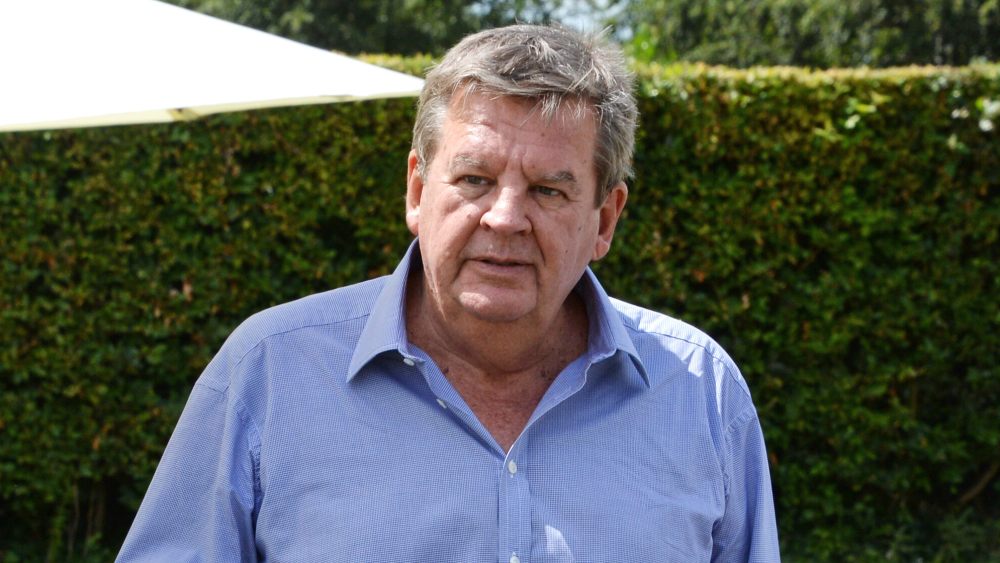
LONDON — Will Richemont pounce, like the Cartier Panthère, on any watch, jewelry or fashion companies this year?
Johann Rupert is mulling the possibility, but he doesn’t want anyone rushing him. And despite the sale of Baume & Mercier to Damiani a few months ago, he’s not keen to dispose of anything in the Richemont portfolio — and definitely not Jaeger-LeCoultre.
During three hours of media and analyst calls following Richemont’s 2025-26 financial results, Rupert talked about his hopes for the luxury giant he founded in 1988, his fears for the future (AI figures big), and offered tips for how to stay ahead of the competition.
You May Also Like
Related Articles
It’s that time of year when Rupert spills his thoughts and spars with analysts and journalists. During the results presentation he was full of vigor after Richemont reported an 11 percent uptick in full-year revenue to 22.4 billion euros at constant exchange. The fourth quarter was even more robust, with 13 percent growth powered by a “very, very good Chinese New Year.”
Operating profit rose 23 percent at constant exchange to 4.5 billion euros, fueled by sales growth across all regions and product categories, and by cost discipline. Profit for the period was 3.5 billion euros, up from 2.8 billion euros in the previous year, and bolstered by the non-recurrence of the Yoox Net-a-porter write-down in the previous year.
Richemont also revealed a net cash position of 8.5 billion euros and, of course, everyone is curious about how it might be spent. As always, Rupert didn’t drop any hints about his future moves.

No Rush to Spend
“We’ve never felt cash flow burning holes in our pocket. We have actually returned close to 100 percent of our free cash flow to our shareholders this year, because we’re pretty certain that we’ve got a reasonable year ahead of us. If an acquisition should come across, then we will be able and willing to pursue that,” he said.
For the moment, he’s savoring the company’s healthy accounts.
“We’ve got a proper balance sheet. Our cash flow this year was dramatically up, and we are relatively relaxed about the next 18 to 24 months of cash flow. I can assure you we are in better shape now than I can ever remember, from balance sheet through tech, supply chain, everything traditional that we could foresee. We’re in great shape,” he added.
And while Rupert is biding his time with regard to acquisitions, he has no interest — at least for now — in any more disposals.
As reported in January, Richemont sold Baume & Mercier to the Italian watch and jewelry group Damiani in a private transaction, the terms of which were not disclosed.
At the time analysts welcomed news of the sale, with Kepler Cheuvreux noting that Baume & Mercier “had struggled for years,” and that Richemont found it difficult to reposition the brand, which sits at the bottom of the luxury pyramid, far away from the group’s other watch brands.
Baume has around 100 million euros in revenues and is loss-making. The deal is set to close later this summer.
“It’s sad because Baume was one of our very first maisons, but one must realize that we are not their best owner. We have very fixed cost structures, and they need more flexibility. They need to be able to act more entrepreneurial. They always did very, very well in Italy — they are really an Italian brand — and we wish the new owners luck. We tried, but sometimes you are better in somebody else’s hands,” Rupert said.
He dismissed speculation that Richemont was ready to offload other watch brands. “It’s nonsense about Jaeger” being sold, he said — talk of which had raged throughout the most recent Watches and Wonders exhibition in Geneva. “They are two or three bloggers who really don’t have a clue, and who are stirring nonsense. It’s a lie, and [a sale] was never discussed,” he said.
Rupert described Jaeger as “the watchmaker’s watchmaker. The maison can do nearly every component of a watch — except for maybe crocodile skin or lizard straps — and they have helped so many of the other maisons when they ran into trouble. We’re very loyal to them. They make phenomenal watches.”
Rupert also lifted the veil on some of the group’s commercial strategies, and why he’s confident about Richemont’s performance in the year ahead.
Able to Plan
He said that while it may look like Richemont is smashing its luxury rivals in terms of sales growth and profitability, the situation is not what it seems.
“We don’t do ‘spring’ lines or ‘cruise’ lines. In our business there is a long time between when our designers start conceptualizing a collection and when we offer it, which means we have a pretty good idea of whether something is going to sell or not. We also hedge just enough to be able to tell our watch and jewelry manufacturers” to work within their budgets and price competitively, he added.
Rupert also talked about his old-fashioned approach to market research.
“I have been doing ‘mystery shopping’ for the past 30 to 40 years. I talk to the sales ladies because they are the ones dealing with the customers and I ask them, ‘What do you think is hot?’ — and then in the end I reveal who I am. I even go and stand on street corners and I count [customers]. Have you ever stood outside, or inside, a shopping mall and counted the people walking into Hermès?” Rupert asked one analyst.
He added that to be successful in business, “You’ve got to pick up what’s not obvious; you’ve got to pick up nuances. You have to use your nose, talk to your friends, ask them what they like, and what they think” of certain collections and products.
Rupert talked about his fears, too, some of which revolve around AI.
“What scares the living daylights out of me is stuff that I really don’t have a clue about and how it will affect us,” he said. He talked about agentic, or nuanced AI, his fears about cybersecurity and his belief that AI will soon be deployed to “fight” enemy AI in order keep companies safe from hackers and viruses.
As confident as he is about the future, the company’s cash flow and product pipeline, Rupert said there’s always something that can fly out of left field and which no one is prepared for. “The real issues are things that we cannot foresee,” he said.
Rupert discussed the ongoing geopolitical crises, and said the only solution for businesses “is to start thinking of the turbulence of the world as the new normal. If it’s not Venezuela, it’s Iran. We just need to stay out of it, lay low, try to be conservative and have a clean balance sheet,” he said.
Bernstein’s Luca Solca listened closely and raised the broker’s guidance on Richemont.
“The brands remain highly desirable, and we believe this top-line momentum is likely sustainable. As Mr. Rupert kindly pointed out, we do track foot traffic in shopping malls, and saw positive trends in May’s data. And we believe relative competition from gold jewelers in China will continue to ease,” Solca wrote in a report following the marathon morning of Richemont presentations.
Bernstein raised its top-line forecasts to account for the Richemont brand momentum, and is now forecasting a 10.5 percent uptick in jewelry sales at constant exchange for the current fiscal year, and group sales growth of 8.9 percent.
It was an added dose of optimism in a sector that needs a lift.