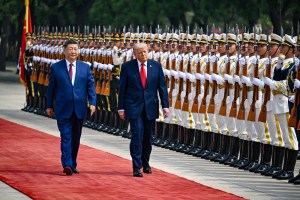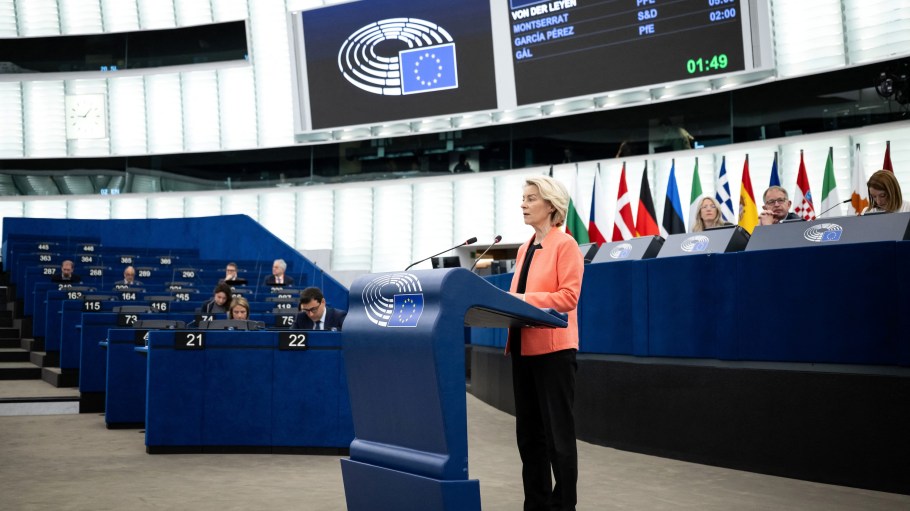
The European Union approved the implementation of its long-delayed trade deal with the U.S. early Wednesday, setting the stage for the agreement’s ratification ahead of a July 4 deadline.
After more than five hours of overnight talks in France, representatives from the European Parliament, the Council of the EU and the European Commission agreed to enact the deal, first struck last summer in Scotland.
Under the “Turnberry Agreement” trade pact, Brussels would end import tariffs on industrial and farm goods and grant preferential market access to U.S. farm and seafood produce, while Washington would put a 15 percent duty on nearly all European exports.
Related Stories
With the compromise, the EU lawmakers hope to avoid steeper tariffs threatened by President Donald Trump, who had said he would hike EU auto tariffs from a 15 percent baseline to 25 percent if the July 4 deadline wasn’t met.
“The EU and the United States share the world’s largest and most integrated economic relationship. Maintaining a stable, predictable and balanced trans-Atlantic partnership is in the interest of both sides,” said Michael Damianos, minister of energy, commerce and industry of the Republic of Cyprus, in a statement. “Today, the European Union delivers on its commitments. We are and will remain a trusted and reliable partner in global trade. We have ensured in our agreement robust safeguards to be able to protect European interests, businesses and workers.”
A vote to ratify the deal is expected to take place June 15-18.
Ratification votes were postponed twice earlier this year. A January ballot was nixed after President Trump repeatedly threatened the EU that the U.S. was interested in seizing Greenland from Denmark. A month later, the vote was again pushed back after the U.S. Supreme Court ruled that the International Emergency Economic Powers Act (IEEPA) tariffs that jump-started the trade negotiations were unlawful.
“It’s been a rocky journey, but it was worth it,” said Bernd Lange, chair of the European Parliament’s committee on international trade, in a statement. “By setting the commitments under the joint statement into law, this regulation becomes part of the EU’s toolkit to improve EU-U.S. relations but also responds to pressure.”
For months, there had been an internal dispute among EU representatives over the potential terms of a provisional deal.
The parties ended up agreeing on a safeguard mechanism that would allow the 27-member bloc to suspend its side of the deal if the EU endured an excess flood of imports that was deemed harmful to European producers and local businesses.
Under the approved text, the European Commission can partially or completely halt the deal if the executive body deems that the U.S. doesn’t meet commitments set out in the initial arrangement, or if it feels discriminating against or targeting EU economic operators.
The text also enables the Commission to suspend the pact if the U.S. continues to apply tariffs higher than 15 percent on steel and aluminum by Dec. 31. Ahead of the meeting, many members of Parliament had floated a “sunrise clause” in which the EU duty reductions would only take place on the condition that steel and aluminum tariffs were lowered from as high as 50 percent. But that clause was axed in the final agreement
Legislators had pushed for adding a “sunset clause” as well, which would give the deal a March 31, 2028, expiration date unless it was renewed. However, the EU’s negotiators ultimately settled to keep the agreement in place until the end of 2029, with the possibility of extending it further.
Lange said the introduction of the sunset clause and a “strong” suspension clause has “substantially improved” the Commission proposal.
The compromise also extended the parties’ suspension of tariffs on lobster until July 31, 2030, tacking on five years retroactively from Aug. 1, 2025.
Under the original terms of the Turnberry Agreement, the EU also commits to investing $600 billion across several sectors in the U.S. economy through 2028 and will purchase $750 billion in energy from American sources.
The EU and the U.S. have a bilateral trade relationship that represented almost 30 percent of global trade in goods and services and 43 percent of global GDP in 2024. But the partners have had a more tenuous rapport under the Trump administration due to the shifts in U.S. trade policy, alongside friction regarding American military and security commitments to the continent.