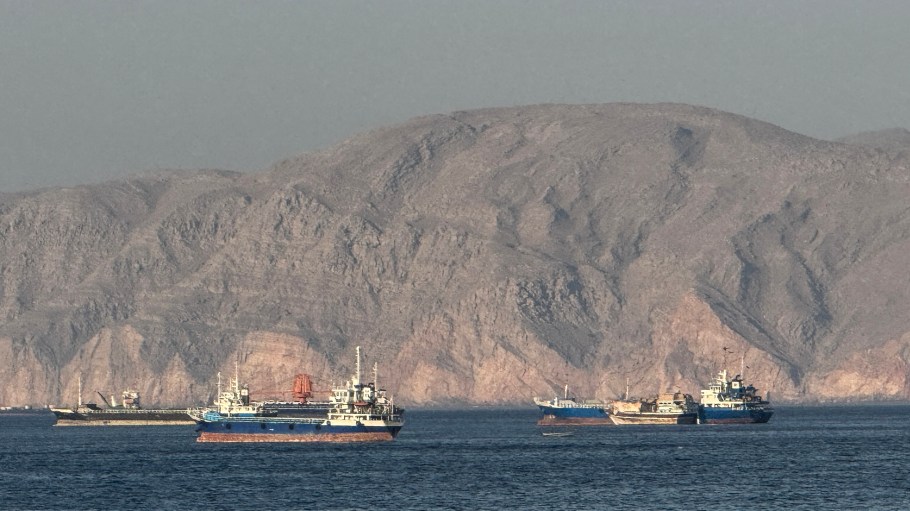
Although U.S. officials said Sunday that there was an agreement in principle in which Iran would allow commercial ships to begin passing through the Strait of Hormuz safely, American airstrikes in southern Iran have endangered a fragile ceasefire between the parties and further cast doubt on the status of shipping through the conflict-ridden conduit.
With both sides suggesting talks on a peace deal were progressing but “not imminent,” Secretary of State Marco Rubio said Tuesday morning that the Strait of Hormuz must be opened for unrestricted navigation “one way or the other.”
Related Stories
But officials out of Tehran have offered mixed messaging on their plans for the strait.
Ahead of the Monday morning strikes, Iran’s foreign ministry spokesperson Esmaeil Baghaei said the Islamic republic is “not seeking to collect tolls” for passage despite the recent launch of an authority to keep the strait under a permission-based mechanism. But Baghaei added that certain navigational services would “require the collection of certain fees,” namely for environmental protection in the region.
A report from the Wall Street Journal Tuesday morning said the U.S. Navy has restarted assisted vessel crossings through the strait. The report cited U.S. military officials, who said the Navy guided a Greek super tanker laden with 2 million barrels of crude oil through the waterway off the Omani coast.
A spokesperson for U.S. Central Command later denied the WSJ report, as well as the assertion that the Navy was renewing the short-lived “Project Freedom” initiative from early May.
According to Judah Levine, head of research at Freightos, more vessels are bunching closer to the Persian Gulf side of the Strait of Hormuz in hopes that the waterway may open soon.
“When the strait does reopen, ships will rush to exit, but out of concern over getting closed in again, carriers may not be as eager to return to regular Gulf port calls until they are convinced that the region is stable and that transiting is safe,” Levine said. “A reopening could lead to some congestion at Far East ports when unscheduled vessels start arriving.”
On Monday, two transits were confirmed by ship tracking intelligence firm MarineTraffic, one being a sanctioned vessel and the other being a “low-risk” ship. Both crossings used the “Larak Corridor” route established by the Islamic Revolutionary Guard Corps that loops around Larak Island closer to the Iranian coast, which MarineTraffic indicates has been the dominant passageway through the strait throughout May.
Ana Subasic, trade risk analyst at MarineTraffic, said the lack of an imminent agreement keeps the operational picture of the Strait of Hormuz fragile.
“The low crossing count shows that the absence of fresh attacks has not translated into a normalization of traffic. Instead, vessel movement remains narrow, route-dependent and heavily conditioned by Iranian clearance practices,” said Subasic in a Tuesday morning blog post. “Even if the ceasefire holds, Hormuz access is likely to remain selective until there is a clear settlement on whether transits return to the IMO-regulated system or continue through Iranian-controlled routing.”
Oil prices fell Tuesday morning on the weekend’s news of a potential deal, with crude oil futures having decreased more than 4 percent to more than $92 a barrel. But a return to prewar supply and price levels would take months even if oil were to begin flowing through the strait like normal.
The ocean freight rate bump initially catalyzed by the bunker fuel spikes continues to elevate further amid signs of an early peak season on the Asia-to-Europe trade lane with more carriers implementing general rate increases in May and June.
Drewry’s World Container Index (WCI) increased 6 percent to $2,712 per 40-foot container, mainly due to more double-digit spikes from Asia to Europe. Freight rates from Shanghai to Rotterdam surged 15 percent to $2,773 per 40-foot container, and those from Shanghai to Genoa jumped 10 percent to $4,082 per 40-foot container.
Drewry’s Container Capacity Insight assessment indicated that only three blank sailings have been announced on the Asia-to-Europe trade route this week, indicating higher capacity deployment to accommodate peak season cargo.
Data from container tracking company Vizion posted on May 20 indicated that China-to-Mediterranean cargo increased 48 percent in the two weeks prior to 82,372 20-foot equivalent units, while China-to-Northern Europe increased 37 percent to roughly 140,000 TEUs moved.
Effective June 1, Mediterranean Shipping Company, Hapag-Lloyd and CMA CGM have all set new freight all kinds, or FAK, rate levels for June 1. MSC, for example, will increase its FAK levels from $4,500 per 40-foot container to $4,700, and expand the price on the same container to the West Mediterranean from $4,500 to $5,500.
The carriers are hiking their peak season surcharges on the route as well, with CMA CGM tacking on a $500 per TEU charge on Asia-to-Northern Europe containers and Maersk adding a $300 charge for Northern European and Mediterranean-bound boxes.