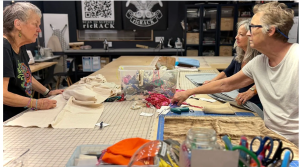
A little over a decade ago, Susan Walker was in the midst of a career pivot. She’d recently left her job and enrolled at the Savannah College of Art and Design, studying textile processes such as weaving, dyeing and spinning. Through her studies, Walker began traveling to source textiles, meeting women artisans who still practiced complex handcraft techniques passed down for generations, such as needlework, ikat dyeing and beading.
“There were women who still carried these skills and knew how to make these amazing things, and because of my studies, I knew how complex their skills were,” Walker said. “I saw that their work was better than I mine would ever be.”
Related Stories
So instead of pursuing her own career as a maker, Walker decided to create a marketplace for the work of these women. That idea became Ibu, a Charleston, South Carolina-based purveyor of clothing, accessories, home goods and gift items created by women artisans from Kenya, Uzbekistan, Colombia and Peru, among other countries.
Ibu operates with a focus on four pillars to bring positive change into the lives of the women artisans it works with—marketplace, capacity building, education and artist engagement. Creating a viable marketplace that operates online, at their Charleston brick-and-mortar store and through trunk shows held in boutiques across the nation underpins Ibu’s strategy for helping women artisans translate their skills into a reliable income.

“Our marketplace is a chance to tell the story,” Walker said. “When you talk about the artisan and customers can see the women making these things, and then here’s the dress those women made with their own hands, it really has an impact.”
Walker connects with makers through networks and events such as the International Folk Art Market in Santa Fe, New Mexico, where the work of vetted global artisans is on display. She said this event has allowed her to cultivate relationships with several women makers, and those relationships have led to additional partnerships via word of mouth.
Ibu follows a typical wholesale model, wherein Walker purchases goods from the artisans and then sells them on her website and in the Charleston showroom. But unlike traditional wholesale, Walker said her partnerships with the artisans are personal and collaborative, with the goal of making the woman successful.
“If their product doesn’t sell, we don’t just drop them,” Walker said. “We talk to them and try to figure out why it’s not selling and what can we do better.”
Building true relationships with artisan partners also means working with them through the unexpected challenges that can impact production deadlines, such as natural disasters or political unrest.
“We work with them on the deadlines because they know how important it is to get things in on time for our photo shoots and everything on our end, but sometimes they have disruptions that cannot be helped,” Walker said.
Ibu also offers artist grants and other support through its capacity-building focus. These grants help provide updated equipment, supplies, workspaces and training for partner artisans.
“It was clear early on that different groups were not on a level playing field,” Walker said. “So we began offering these grants, and it has been so exciting to see things like a group in Nigeria who were working outside because they didn’t have electricity. We were able to get them solar lights and build a whole new workspace—the dollar goes a lot farther in some of these communities.”
Those grants are possible since Ibu isn’t just a retail operation, but also a nonprofit. And Walker said their donors don’t simply write a check and move on—they meet and interact with the women they’re helping through Ibu’s engagement strategy.
“We take our donors and customers to meet the artisans,” Walker said. “We’ve been to Uzbekistan, Colombia, Morocco, Peru and so on. These trips are about women from this country going to meet these artisan women in their workspaces and sometimes their homes, really getting to know them, seeing how they live, who they are and what making these things means to them.”
Those trips also play into Ibu’s education pillar, which focuses on storytelling and teaching consumers about the work involved in a handcrafted item and the associated cost of that craftsmanship.
“In the United States, there’s an expectation that if you go to Italy and buy a handmade leather bag made by a man, you expect it to be expensive,” Walker said. “But if you go to the global south and you find something made by a woman, you expect it to be cheap. But the skills are just as complex and amazing, and it’s our job to tell that story differently.”
That storytelling also includes educating her customers about the cultural significance of the items they buy from Ibu. Techniques such as Moroccan soutache embroidery, mud silk stained by river delta tannins from China, Native American Diné beading and caña flecha weaving by indigenous Colombian women reflect long-held cultural traditions passed down through generations. And those techniques also offer a more sustainable alternative to today’s mass-produced fast fashion.
“Women have been working with the earth over millennia to grow the fibers they’re going to use, to create the natural dyes, to basically work with the land,” Walker said. “And then it’s handiwork, powered by women’s hands—it’s sustainable, slow fashion.”
Walker said Ibu has begun partnering with larger brands for limited edition collections, such as a curtain line with Schumacher textiles featuring work by women from Kyrgyzstan, and they’re open to other collaborations that will help expand the reach of their artisans’ work.
“We want to get them in front of other brands and designers because the end goal is to help these artists scale and sell more,” she said.