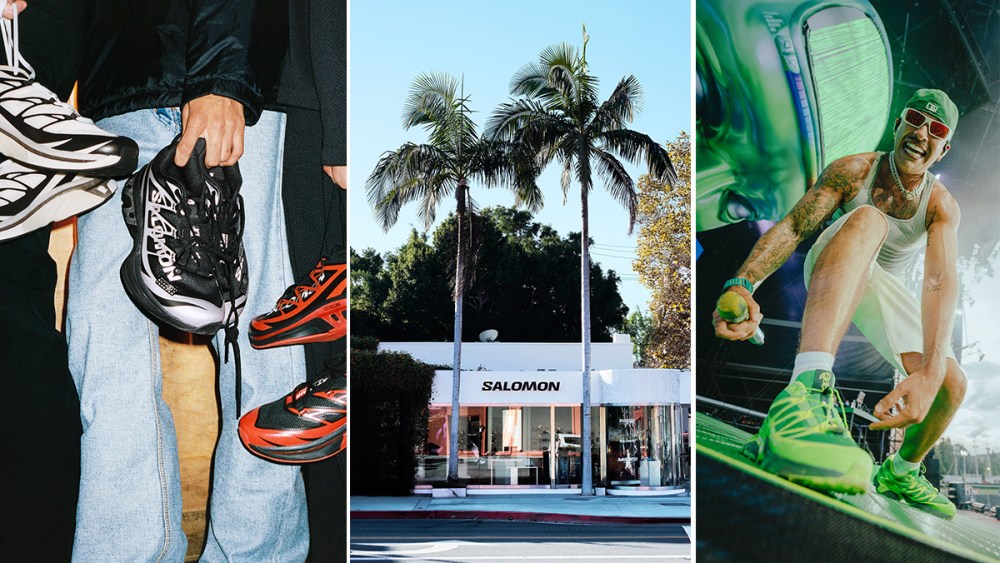
Take a stroll along the streets of Brooklyn or scroll through TikTok and chances are you’ve seen someone stylish sporting a pair of Salomon sneakers.
But for the nearly 80-year-old French mountain sports brand, there was no grand plan to cater to the street-style crowd. In fact, for Guillaume Meyzenq, president and chief executive officer of Salomon, it was unexpected.
“We are not a fashion brand,” Meyzenq told FN in an interview at the company’s New York offices in May. “And we wouldn’t know how to make it just solely as a fashion brand, either. But what we’re good at is anticipating what could be the next essential for the consumer. We’ve also realized it’s OK if we want to make people dream and get inspired.”
You May Also Like
Related Stories
Of course, the intersection of the fashion and outdoor worlds isn’t new. Salomon began to resonate with a new consumer during the pandemic, when more people were starting to experience the city with a different mindset — from riding a bike to a casual stroll.
“Around that time, we also started to be connected with people [and companies] who are shaping the future of sports and fashion,” Meyzenq explained, “like [German menswear designer] Boris Bidjan Saberi and [Parisian retailer] The Broken Arm, which is still a retailer of ours. These partners allow us to tap into the culture and build a new community around Salomon that can help us tell a different story.”

That storytelling is a reflection of Salomon’s new attitude toward its footwear. Historically, innovation has supported the evolution of products like the XT-6, launched in 2013 and originally designed for ultra-distance trail runners facing harsh conditions. This silhouette has since become the foundation of Salomon’s rapidly growing Sportstyle line, which blends function and fashion in a way that resonates with both athletes and lifestyle consumers.
The collection, which is now the fastest-growing piece of the brand, continues to gain cultural relevance, with high-profile tie-ups such as the XT-MM6 Maison Margiela, the X-Alp Carhartt W.I.P, and the XT-Pathway 2 Ferxxo with Colombian artist Feid.
“We use collaborations like these with the purpose to push the boundaries of the brand and to connect with a new consumer,” the CEO said. “We are not using them to drive business.”
Still, the brand is benefiting from a halo effect — and the proof is in its results. First-quarter demand was strong after a momentous 2025.
“We just passed the $2 billion mark, so we changed completely the scale and the mindset of the company. We were a bit surprised at the beginning about the success, but now you get this external feedback about the brand, which is very positive,” Meyzenq said.
Overall revenue at Amer Sports’ outdoor performance segment — which includes the Salomon, Atomic and Armada brands — increased 31 percent to $2.4 billion in fiscal 2025, up from $1.8 billion in fiscal 2024. And while the company does not break out sales by brand, Salomon was dominant, with shoes as the star of the show.
In fact, Salomon noted that at the end of fiscal 2025, nearly 70 percent of its business was derived from footwear sales. Retail partners like Nordstrom also credit Salomon’s cultural relevance for the brand’s current success.
“Salomon is one of those sneaker brands with a special story and credibility in the alpine- inspired footwear space that quickly became a favorite of fashion enthusiasts,” said Jian DeLeon, men’s fashion director at Nordstrom, citing its well-received collaborations with MM6 Maison Margiela, Sandy Liang and cult skate labels like Andrew and Carpet Company.
Here, FN sits down with Meyzenq, along with Steve Doolan, president and general manager of Americas at Salomon, to talk about what’s selling, store expansion plans and the road ahead.
The footwear category is a definitive bright spot in fashion right now. What’s driving the business at Salomon?
Steve Doolan: There’s no doubt the Sportstyle segment is doing incredibly well, [with] the XT franchise being the leading component of that. What is exciting is the X-Ultra 5 hiking shoes, where we’re seeing real strength in the marketplace in terms of how consumers are reacting and responding to the product. And then we’re seeing great response to the Aero Glide 3, and now Aero Glide 4, our pure road-running products. So we’re excited about what Sportstyle represents, but we’re equally [optimistic] about the performance component of our footwear, which is where we came from, and ultimately what we’ll continue to have in the future.
As brick-and-mortar shows notable strength, take us inside Salomon’s “epicenter” strategy?
S.D.: Our epicenter strategy revolves around opening a handful of brand stores alongside elevated wholesale distribution in key metro markets around the world, which is critical to elevating Salomon’s presence and awareness. As for what merchandise goes where, we think about the consumer in the neighborhood that we’re looking to serve. So, certainly when you’re in SoHo in New York, it is a fashion-driven customer, what I would think of as a leading adopter in terms of fashion and trend. We’ll have more Sportstyle offerings at that location. In contrast, on the Upper West Side, the store is a block from Central Park and there’s a community there for whom running and walking is a consistent part of their lives. Making sure that we brought product that was representative of their needs made sense. [From one of our first Saturdays in the neighborhood], what I noticed is four hydration vests were sold over the course of the day, and that, to me, really speaks to the fact that we’re putting product in there that is meaningful, that’s going to serve the needs of that consumer. Consumer-first is always the name of the game.
Will there ever be a “flagship” Salomon store that has the entire product range?
S.D.: We would have to open a Dick’s Sporting Goods-sized store in order to showcase the breadth of what we have to offer. But what you’ll see at our new Flatiron store that will open in New York in July is a broader assortment across our franchises.
You’ve said publicly you’ll open seven to 10 stores in North America this year on top of the 36 you already have. What markets present the biggest potential?
S.D.: After Flatiron, the next store [opening] that we’ve planned is in October in Beverly Hills. That will be our second store in Los Angeles. Then we’re actively looking for [other] locations in Southern California and in San Francisco, and additional [opportunities] in Chicago, Miami, Washington, D.C., and Boston. We want to be thoughtful. We want to make sure that the stores are right, the size is right, that the consumer is there, that we’re going to be positive in terms of the impact that we have.
How has the Salomon wholesale business evolved in the U.S. in recent years?
S.D.: Two-and-a-half years ago, we went through a significant reset in terms of making sure we are working with the right retailers and then being thoughtful as it pertains to how we drive pricing integrity. We’ve been [strategic] about how we go to market and [have been] resetting a lot of the distribution across every one of the channels that we work with. We’re seeing the benefits of that today. It certainly made for a bit of belt tightening in 2024, but the benefits of that hard work are becoming very, very clear in 2026.
Which retail partners best fit that strategy?
S.D.: We are building a relationship with Fleet Feet, which we’re excited about. REI continues to be the most important outdoor partner that we have; and we’re seeing a growing business with Nordstrom. Looking toward fall 2026, we’re going into business with Foot Locker and JD Sports.
Salomon recently opened its new “hub” in Paris that spans multiple floors and serves as a showroom and a place to host product launches and community activations. How does that fit into your overall strategy?
Guillaume Meyzenq: The Paris hub is another good example of how the brand is transitioning to a different scale. Right now, we have about 25 to 30 employees at the hub, and it serves as a great place to attract talent but also serves as a comfortable place to connect with people.
S.D.: Hubs like the one in Paris is becoming what was envisioned, which is a place that is both global and central to what Salomon is going to become. It better serves us as the business and teams are evolving and Salomon becomes larger and a more mature brand in our own way.
Salomon recently activated during the Milano Cortina Olympic Games. What did you learn?
G.M.: This was the largest investment that Salomon ever made for a partnership. Being so visible at the event also goes along with how we are changing the scale of the company and how we are becoming more global. But one thing we learned is that partnering with large platform events is something that we’re open to doing more in the future.
Guillaume, you’ve been with Salomon for over 30 years. What are the biggest ways the brand has changed?
G.M.: We tell fewer stories, and we’re putting more money, time and focus on the ones we’re telling. This is becoming more visible and compelling for the customer. This is one of the big changes we have been operating toward for the last two to three years, and you will see more of this from Salomon.