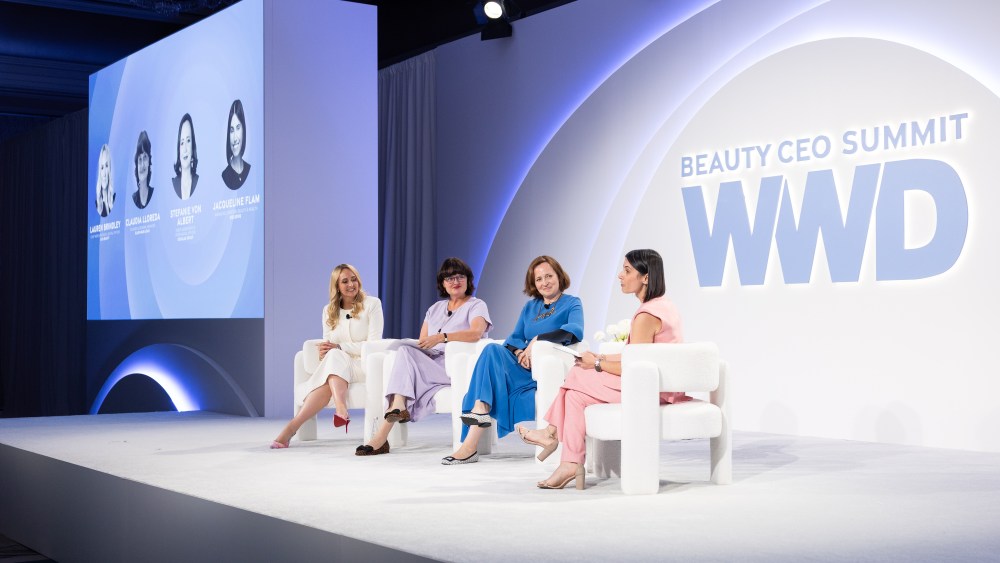
Three top beauty retailers shared how they navigate growth, relevance and trust in today’s increasingly complex operating environment.
Beauty remains among the few product categories still driving gains globally, with sales up 10 percent in 2025, according to NielsenIQ.
“But that growth is happening unevenly and certainly under pressure,” said Jacqueline Flam, managing director of beauty and health at NielsenIQ, during a panel discussion at the WWD Beauty CEO Summit. “Consumers are more selective, value is fragmented and the definition of winning in beauty retail looks very different today depending on the market, model and consumer expectations.”
Related Articles

Douglas Group, the first-ranked European premium beauty retailer, has 1,900 stores in 22 countries. “We believe in a seamless experience between online and offline, and we want to be the most trusted and also the most welcoming retailer for our customers in all our countries,” said Stefanie von Albert, chief assortment and purchasing offer at Douglas Group.
Blush-Bar, according to its founder and general manager Claudia Lloreda, is a “pink specialty multibeauty retailer in Latin America. We offer a happy, kind, high-service store experience.” Blush-Bar has small store formats, of between 645 and 915 square feet, with a highly curated brand portfolio.
“We have a Latina soul and are focused on authentic storytelling,” Lloreda said. Blush-Bar counts 20 stores in Colombia, 25 doors in Chile and nine locations in Mexico. It is expanding into the rest of Latin America.
Ulta Beauty is the largest beauty specialty retailer in the U.S., where it counts 1,500 stores. Eight-five percent of Americans are within 20-minute drive from an Ulta Beauty location, making it both urban and suburban.
“Over the last 12 months, we are now also one of the fastest-growing global beauty retailers in the world,” said Lauren Brindley, chief merchandising and digital offer at Ulta Beauty. The retailer has entered six markets over the last several months. It’s launched in Mexico and the Middle East, and acquired Space NK in the U.K.
Brindley called it all “a huge transformation. We’re just getting started.”
“Our low-to-luxury model is very differentiating,” she said. “We are all ages, all life stages. We are balanced across all the key categories within beauty, and now we’re building into wellness.”
Eighty percent of Ulta Beauty guests are buying prestige and luxury beauty products. “That’s been one of the fastest-growing parts of our business,” Brindley said, adding the retailer is entrepreneurial digitally. It launched its TikTok shop a few weeks ago, and it already boasts 5 million people livestreaming in the U.S. The retailer also introduced its first AI agent, the Ulta Beauty app.
“We’re seeing consumers shop beauty with more intention, higher expectations and clearer value trade-offs,” Flam said. She asked panelists about what the biggest behavioral shifts are driving their assortments and merchandising decisions.
Douglas, which has 64 million people in its customer database, deep dives into understanding what’s relevant for its consumers per country. It focuses on differentiation in line with each product category’s role.
“For example, if I take skin care, our second-biggest category, we want it to be about education expertise,” von Albert said. A Polish dermatologist brand might be launched just in Poland, to service local customers. But Douglas also launched Lancôme’s new Absolue Longevity MD skin care across many countries.
“It really shows what we can do at scale,” von Albert said. That is, a blend of personalization, localization and differentiation.
Blush-Bar recently undertook a study of its community. “What we found was that while consumers remain very ‘positive’ and ‘energized,’ we are seeing more ‘stressful,’ ‘overwhelming,’ ‘uncertain’ [feelings],” Lloreda said, adding consumers’ top priorities are “stability,” “rest,” “softness,” “joy” and “fun.” “So beauty needs to be a lot more nurturing, peaceful and kind to the consumer.”
When asked what beauty means to the Blush-Bar consumer, “self care” ranked first by far, then “confidence” second. That’s versus in 2019, when the top answers were “confidence” and “self-expression.”
“Beauty is developing into a broader definition of wellness, wellbeing, self-esteem, mental health and mental care,” Lloreda said. “So, we’re trying to do more storytelling, more rituals and make Blush-Bar an emotional home for this consumer — a place of respite.”
Ulta Beauty’s strategy, called Beauty Unleashed, is through the consumers’ lens, emphasizing consumer opportunities — such as by media or occasion — rather than by specific category.
“That enables you to see bigger, bolder macro-moves,” Brindley said. “We can see bigger white-space opportunities.”
For instance, Ulta Beauty’s Gen X guests showed there was massive opportunity to unlock new brands and solutions. That cohort said they were not feeling seen and heard, nor were they inspired. The demographic wanted to learn about longevity and new technologies, but in an exciting way. Brindley said such an opportunity can be taken from a merchant or brand-building perspective. “It leads you into hair care, more scientific and medical skin care, different kind of solution sets,” she said.
Brindley underlined the importance of curating the best in beauty and wellness.
Vectors of growth differ by geographic region. In 2025, the U.S.’s beauty business grew 9 percent, predominantly online. The activity gained 4 percent in Europe and 14 percent in Latin America, bolstered by inflation and a strong in-store market, according to NielsenIQ.
So how do geopolitical instabilities impact the retailers’ strategy, and where are their opportunities?
“In Latin America, political and economic turbulence are a day-to-day staple in our lives,” Lloreda said, explaining the global context makes the situation even harder, with transport costs rising dramatically and the supply chain less agile. The consumer is therefore more price-sensitive, discount-driven and measured.
“She’s not just buying everything that’s viral,” Lloreda said. “She needs a lot more education. We are created for the shopper who doesn’t know what she wants to buy.”
Lloreda noted prestige skin care is compressed due to the global context as well as the flood of K-beauty with exceptional quality and reasonable prices. There’s the rise of derm brands, too.
“In terms of hot spots, we are seeing very strong makeup performance, excellent body care performance, and fragrance is through the roof for brands who have a very specific story, a very precise DNA and price accessibility,” she said.
Gen Alpha girls — and boys — are entering the beauty category earlier, influenced by friends, culture and digital.
“What signals are you seeing, and how are those signals already influencing assortment, content and experiences?” Flam asked.
Von Albert said at a recently refurbished Douglas flagship in Cologne, Germany, there’s generally a group of young men aged around 17, who already have deep knowledge about fragrances’ ingredients and are trying out perfumes priced from 250 euros to 350 euros.
“They’re not willing to make a concession,” von Albert said, adding that if individually the teenagers cannot buy a scent with that price point, they will purchase it together with their peers. This leads Douglas to look at its format strategy, whether it’s possible to offer high-quality products in a smaller size or a different texture.
“How are you evolving your model to meet the consumer where they are, rather than forcing them into a single path?” Flam queried panelists.
Shopping centers are key in Latin America. “We continue to see tremendous growth in shopping-mall traffic and new shopping-mall constructions,” Lloreda said.
For Blush-Bar, online is increasingly important, representing more than 15 percent of its sales today, although brick-and-mortar remains core for a plentitude of reasons.
“I’m seeing consumers really want to belong to a larger community,” Lloreda said. “While we are investing in AI, online and — of course — social media and everything digital is supremely important, our view is that humanity, kindness, engagement and warmth are going to define the store well into the future in Latin America.”
What’s a key bet Ulta Beauty is making? Beside the merging of beauty, wellness and well-being, it’s also wagering that brands building into white spaces will be the global brands of the future.
“I 100 percent agree the stores will be the heartbeat of our business,” Brindley said. “But I’m really excited about what AI can do for our industry, and how it can potentially automate the repeatable, utilize that data to turn insights into even bigger and better innovation, so that we can really drive even further growth for this industry in the right way.”
Operations might be removed from stores enabling their magic to come to life in new ways. “The future is very bright,” Brindley said.
While Douglas incorporates AI and other technologies, von Albert remains passionate about personal human connection. She’s excited that services, considered by the retailer as the sixth category after beauty’s five classic product categories, are being built out and at the store’s center.
Blush-Bar is launching its own private-label brand. “It’s going to be inspired by the beautiful, magical flora of Colombia,” Lloreda said.