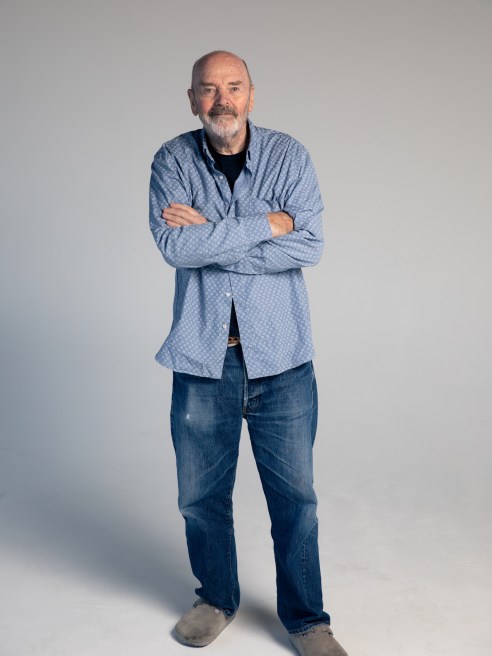
Before there were Instagram and TikTok personalities shaping trends, there was Adriano Goldschmied—the unofficial influencer of the denim industry, setting trends and sparking conversations through his relentless curiosity and genuine passion for creating better products for consumers.
The Italian designer widely regarded as the “Godfather of Denim,” died in April at the age of 82 following a battle with cancer.
Tuncay Kılıçkan, Lenzing Group’s head of global business development for denim, said whatever Goldschmied championed became the new target for the supply chain. “This led him to be a pioneer for the industry. He never gave up or retired completely. He used to join all the important shows to get updated. That’s why he was never outdated,” Kılıçkan said.
Related Stories
Collaborating with Goldschmied served as a “seal of approval” for companies across the denim supply chain. If Goldschmied chose your fabric or technology for one of his collections, it carried weight. And when he partnered directly with a fiber producer or technology company to spotlight their innovation, it often elevated the product from promotional to aspirational.
For Artistic Milliners, working with Goldschmied signaled to the global market that vertically integrated denim manufacturer is for innovators. The company stated that their partnership “opened doors to premium brands and boutique labels that value the intersection of craft and technology, reinforcing our position as a leader in the R&D space.”
“Over the years, there were a number of our technologies he supported, either for his own brands or for the work he was doing on behalf of other brands and retailers,” said Jean Hegedus, sustainability consultant for The Lycra Company.
The Lycra Company worked closely with Goldschmied on several initiatives, including the 2006 launch of Lycra XFIT technology, which brought four-way stretch to jeans. He was the perfect candidate to help promote a stretch product. “As early as the ’70s and ’80s, he was experimenting with bringing some level of stretch to jeans,” she said.
Soko’s relationship with Goldschmied began simply: he was initially drawn to the chemical company’s Lumia technology for his Daily Blue brand. Over time, their partnership evolved, with Goldschmied incorporating Soko’s solutions into additional projects, including his collection for Italian retailer OVS.
“Adriano was not someone who would easily align himself with companies unless he was fully convinced of their values and approach. He genuinely appreciated our way of working and our commitment to innovation, which led to the development of a strong and meaningful relationship. He firmly believed in the power of synergy among players across the supply chain,” said Matteo Urbini, Soko general manager.
Christian Reca, Pioneer Denim’s worldwide marketing and merchandising manager, said collaborating with Goldschmied positioned the company as not only being technically advanced but also culturally relevant within the denim space. “It allowed us to engage with brands on a different level: less transactional, more strategic and creative. It also opened the door to new conversations, particularly with premium and forward-thinking brands that value both authenticity and innovation. His involvement naturally brings visibility, but more importantly, it builds credibility around the work we are doing,” he said.

That said, Reca said building a shared vision and mutual trust took time. “Especially at the beginning, earning Adriano’s confidence was a process, but day by day we established a strong and solid relationship,” he said.
Advance Denim collaborated with Goldschmied continuously for the past decade.” Mark Ix, the mill’s director of North American marketing, said the relationship was born out of a mutual respect between Goldschmied and Advance Denim’s general manager Amy Wang.
“Amy and Adriano would discuss Advance Denim’s constant stream of innovations and sustainable technologies,” he said, noting that Goldschmied recognized the mill’s ability to invest in new ideas and bring them into large-scale production.
“[He] was aware that true sustainable change starts with the technological knowledge on the mill level with the true technicians that work with the product day in and day out,” Ix said.
Curious and creative
Goldschmied had a rare ability to take something highly technical and make it real for the denim industry, according to Avalo chief commercial officer Tricia Carey. “He understood authenticity, but he was never limited by it,” she said.
Carey worked with Goldschmied throughout her 24 years at the Lenzing Group, though she noted that his involvement with Tencel lyocell dates back even earlier—to the late 1990s, when the branded fiber was still part of Courtaulds. In 1997, his Agolde brand launched a Tencel denim collection.
At the time, Carey said Tencel was “a breakthrough,” especially for the denim world. The unique aesthetics of fabrics with Tencel fibers meant that designers were able to create apparel with a previously unheard level of softness and drape. “Even then, he saw the potential for Tencel to bring a different hand feel, drape, and performance into denim,” she said.
Goldschmied’s intrigue in Tencel led him to Jeanologia, which was developing a way to treat the fiber through fibrillation and later defibrillation. That development contributed to what later became the soft denim boom at the end of the 1990s, according to Enrique Silla, founder and CEO of Jeanologia. From the beginning, Silla said Goldschmied saw the potential of combining innovation with fabric behavior to redefine how denim feels.
“I remember very clearly the first industrial ozone machine we introduced in denim in 2008, which was also scalable. Adriano immediately fell in love with the results, especially with how it could modify the cast of indigo in a very natural way,” he said. “We really enjoyed working together on that project. It was one of those moments where technology and creativity meet and push each other forward.”
Goldschmied wasn’t just chasing a new aesthetic—he was tuned into consumers’ needs. “He was very much convinced that today’s consumers are addicted to comfort and hand feel of clothes, so he pushed the industry towards a gentler hand feel without compromising from the genuine denim look,” Kılıçkan said.
Marco Lucietti, director of strategic projects for Isko and head of global marketing and communications for Re&Up, said Goldschmied was as much a researcher as he was a designer.
“While many focus purely on the aesthetic of the final garment, Adriano was deeply interested in the ‘why’ behind the fabric. He would spend hours discussing the technicalities of the weave. He understood that you cannot revolutionize fashion without first mastering the science of the textile,” he said.
Visionary at work
Goldschmied exemplified what it meant to be a visionary.
“He took the classic five-pocket vintage jean and elevated it into a lifestyle product. He showed that denim could be sophisticated, emotional, and expressive,” Silla said.
His work was never truly finished. Goldschmied was always pursuing a new idea, refining a concept or creating something unexpected. “What struck us most was that he was never defined by what he had already accomplished, but rather by what he still had the potential to create. That forward-looking mindset is what truly made him an innovator,” Urbini said.
Artistic Milliners recalled how Goldschmied embraced high-stretch denim and denim with a knit appearance at a time when the industry was still tethered to heavy cotton constructions.
Reca noted how Goldschmied consistently challenged the notion that denim must adhere to rigid codes whether in terms of weight, texture or appearance. He did this by encouraging the mill to experiment with softness, fluidity, and new constructions.
“This led to developments that blur the line between traditional denim and more contemporary fabric categories, expanding how denim can be used and perceived. His approach invites the industry to rethink comfort, performance and aesthetics without losing authenticity,” he said.
Carey said he challenged the idea that denim had to be “rigid, heavy and purely cotton” by introducing fibers like Tencel to create softness, drape and a more refined hand feel without losing authenticity. He pushed mills and laundries to rethink washes and finishes, showing that performance and sustainability could sit alongside heritage. His openness made it acceptable to evolve denim, she added.
“What stood out to me over the years, especially around 2011 when cotton prices were at their peak, was how boldly he spoke about the need to think beyond cotton. He didn’t treat Tencel as an alternative; he treated it as an evolution of denim,” Carey said. “Through his collections and his work with mills and laundries, he validated the fiber in a very commercial way. He gave the industry confidence that innovation could sit alongside heritage, and that shift in mindset was incredibly important for Lenzing and for the broader adoption of new fibers in denim.”
Compared to other designers, his collaborators said Goldschmied was clear and intentional with his vision from the very beginning of a project.
“He liked to build on ideas, layering innovation, materials, and storytelling in a way that pushed the concept further each time. He also operated with a level of discipline that kept things moving. He was responsive, thoughtful, and consistently came back within 24 hours, which made collaboration efficient and productive. It created a rhythm where ideas didn’t stall,” Carey said.
True collaborator
Goldschmied worked closely across the denim supply chain because he understood how to build product from raw materials and believed innovation comes from combining every component. He wanted to be inside the process, shaping fiber, fabric and finish together rather than designing at the surface, Carey said.
“Adriano’s greatest gift to the industry is his generosity with knowledge. The denim world is more collaborative and forward-thinking today because of his enduring influence,” said Artistic Milliners and ArtMill.
Goldschmeid’s collaborations were never ordinary, according to Luca Braschi, Soko marketing and technology manager.
“Every wash, every detail required research, care and genuine innovation. With him, nothing was ever taken for granted—everything had to be special,” Braschi said. “Working alongside him—we didn’t just create, we grew. We learned. We evolved. Because that is what happens when you sit next to a master. He was an inexhaustible source of ideas, vision, and direction, always looking ahead, always able to anticipate what was to come.”
Despite his legendary status, Lucietti said Goldschmied had an “incredible level of participation” in what mills produced. “He understood that the future of denim wouldn’t be found on a sketchpad alone, but in the laboratories and on the looms,” he said, adding that Goldschmied’s tireless commitment to spreading ‘denim culture’ made him a natural partner for Isko.
“He wanted to be where the heat was…He didn’t just want to make jeans; he wanted to educate the world on what denim could be,” Lucietti said.
Isko’s relationship with Goldschmied was built on a shared language of textile evolution. One example of that was the development of Moonskin, which Lucietti said pushed boundaries of what a denim surface could achieve in terms of sheen and hand feel.
Artistic Milliners and ArtMill’s collaborations with Goldschmied were rooted in pushing the boundaries of denim. Several collections focused on merging “heritage aesthetics with futuristic performance,” especially hybrid fabrics which Goldschmied championed well before the pandemic made versatile, comfort-driven fashion the industry’s defining priority. Their R&D projects with Goldschmied explored wool blends, continuous filament lyocell and innovative washable indigo prints.
“As the ‘Godfather of Denim,’ Adriano’s reputation as a disruptor precedes him. We were initially drawn to his ability to view denim not merely as a commodity, but as a canvas for lifestyle innovation. His legacy provided the confidence that any project we undertook would not only be commercially viable but would also set a new benchmark for the global industry,” the companies stated.
The teams at Artistic Milliners and ArtMill saw how Goldschmied focused on the “soul of the fabric” and possessed “technical curiosity.” He didn’t just request a fabric—he would dive deep into the spinning, dyeing, and the molecular composition of the fibers.
“What makes our collaboration unique is how he utilizes our end-to-end capabilities. Because we control the process from fiber to finished product, Adriano could influence design at the yarn stage, dictate the precision of the cut, and experiment directly in our laundry to refine garment finishing,” they stated.
Carey said working with Goldschmied was always creative and grounded in real product, whether it was Modal Indigo for indigo knits, linen/Tencel blends for T-shirts or a concept collection for the launch of Refibra. “What made it special was that there was always another idea to explore together,” she said. “It never felt like a single project. There was always momentum, always a next step, and that continuous collaboration is really what drove impact.”
Hegedus experienced his determination to innovate firsthand. She recalled Goldschmied showing her a pair of jeans he had developed with 80 percent stretch made from cupro and 2 percent Lycra fiber. Unsatisfied with the shrinkage, he shifted the conversation toward finding a solution.
“I brought this problem back to our [technical and development] fellow, Tianyi Liao, and after some discussion and trials, we combined Lycra fiber and Lycra T400 fiber into a single corespun yarn [Lycra dualFX technology] and brought this back to Adriano. This enabled him to achieve very high stretch with great shape retention. This innovation was adopted by the premium market and later by more moderately priced brands,” she said.
Lasting legacy
“He had something rare: a vision driven by curiosity and a deep passion for innovation,” Braschi said.
Goldschmied belonged to a fading generation of denim visionaries who understood product creation from the fiber up.
“Adriano realized early on that true innovation starts at the source. By working directly with the mill, he could bypass traditional limitations to develop proprietary textures and washes that weren’t available off-the-shelf. He understood that the supply chain is the engine room of the denim industry,” Artistic Milliners and ArtMill stated.
Rather than focusing only on surface design, Carey said he immersed himself in every stage of the process—shaping the fiber, fabric and finish together rather than designing at the surface. His curiosity about technology and his ability pulled insights from everyone around him fueled each new project.
“He had this belief that you learn by working with all parts of the industry—listening, collaborating and constantly exchanging ideas. What stood out, and honestly surprised me, was his commitment to meeting in person; with feet on the ground, traveling, visiting mills and laundries, and learning directly from the process,” Carey said.
The teams he encountered during those visits gained something in return: Goldschmied’s expertise, enthusiasm and relentless pursuit of improvement.
Reca described working with Goldschmied as less about following a directive and more about engaging in a dialogue. “His energy, curiosity and critical eye pushed everyone in our team to raise their standards,” Reca said. “At a time when the industry is redefining itself balancing heritage with responsibility and innovation, voices like his remain essential.”