The Department of Justice has indicted four Chinese shipping container manufacturers and seven individual executives on charges of artificially restricting the output of containers to fix prices during the Covid-19 pandemic.
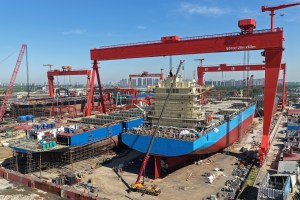
China International Marine Containers (CIMC), Dong Fang International Containers, CXIC Group Containers and Singamas Container Holdings, were charged with allegedly colluding to limit the production of new unrefrigerated shipping containers between 2019 and as late as January 2024.
Related Stories
As a result, the prices of these containers more than doubled between 2019 and 2021, with acting assistant attorney general Omeed Assefi indicating in remarks Tuesday that the defendants triggered a global shortage of shipping containers.
According to the indictment, the four defendants—along with two other unnamed container manufacturers listed as co-conspirators—produce about 95 percent of the total standard dry containers available worldwide.
One executive, Vick Nam Hing Ma, was arrested in France in April. His extradition to the U.S. is pending. Three of the other six individuals charged were CEOs of CIMC, CXIC and Singamas.
“Global price-fixing cartels strike at the heart of our economic liberty. The defendants held hostage the world’s supply of ocean shipping containers during the Covid pandemic when our supply chains needed it the most,” said Assefi in a statement. “They stole from everyday Americans who paid more and waited longer for vital goods as a result.”
According to the indictment, discussions of a price-fixing scheme began in March 2019, with various executives taking the conversation further on Nov. 14 in CIMC’s Shenzhen headquarters.
During that meeting, executives from CXIC, Dong Fang, CIMC and one of the unnamed co-conspirators allegedly agreed to restrict their container output via various means, including limiting the number of shifts and hours that each production line could run per day and installing video surveillance to ensure that the companies did not exceed the agreed-upon limitations.
The parties also agreed to stop building any new container manufacturing factories and establish a mechanism to penalize any of the firms from cheating on the agreement.
Although Singamas and the other unnamed container manufacturer were not at that meeting, they joined the output restriction agreement as early as March 2020, prosecutors allege. That month, the six companies signed a written deal to put the practices into place.
Prosecutors contend that the conspirators also worked to halt the growth of smaller competing standard dry container manufacturers by undercutting prices on certain boxes.
“On or around August 7 and 10, 2023, the conspirators discussed waging ‘war’ against smaller manufacturers outside the conspiracy,” said the 18-page indictment. “The conspirators sought ‘to strike back by [creating a] price war against these small factories.’”
From as early as September 2022 until at least as late as November 2023, the companies would restrict the total cargo volume of containers they produced, as well as the number of containers they would ship to various customers, including major U.S. firms, the DOJ said.
The executives repeatedly tried to conceal their actions, prosecutors alleged, and one unnamed Singamas executive raised concerns about antitrust violations and the potential to be sued by clients.
The accusation was filed in a California federal court in January, before being unsealed Tuesday.
The indictment followed a 2022 report from the Federal Maritime Commission (FMC) circulated by two of the CMIC executive defendants in efforts to conceal the scheme. That report found that when demand for ocean containers increased during the pandemic, Chinese-based intermodal equipment manufacturers were “notably slow in ramping up production, raising the question of whether this was part of a deliberate strategy to manipulate prices.”
That year, CIMC abandoned its intended $987 million acquisition of Maersk’s own container manufacturing subsidiary following a Justice Department investigation. According to the department, that deal would have consolidated control of more than 90 percent of insulated container box and refrigerated shipping container production worldwide in Chinese state-owned or state-controlled entities.
Container manufacturers are just one group of container shipping industry stakeholders that have garnered scrutiny from U.S. government agencies for their business conduct during the pandemic.
Ocean carriers have been under the microscope since the swell of supply chain bottlenecks experienced in 2021 and 2022 due to various complaints levied by American shippers and freight forwarders alleging they were engaging in anti-competitive behavior. The grievances centered on carriers’ record-high freight rates, excessive late fees and chronic failures to honor—or outright skip—service commitments.
As the complaints piled on, Congress voted to expand the powers of the FMC via the Ocean Shipping Reform Act of 2022 (OSRA), giving the agency the authority to investigate and penalize carriers for unreasonable practices. The legislation also put a heavier burden on carriers to prove their compliance by requiring them to report more detailed information on import and export tonnage.
The indictments come just one week after U.S. President Donald Trump traveled to China for meetings with Chinese President Xi Jinping.