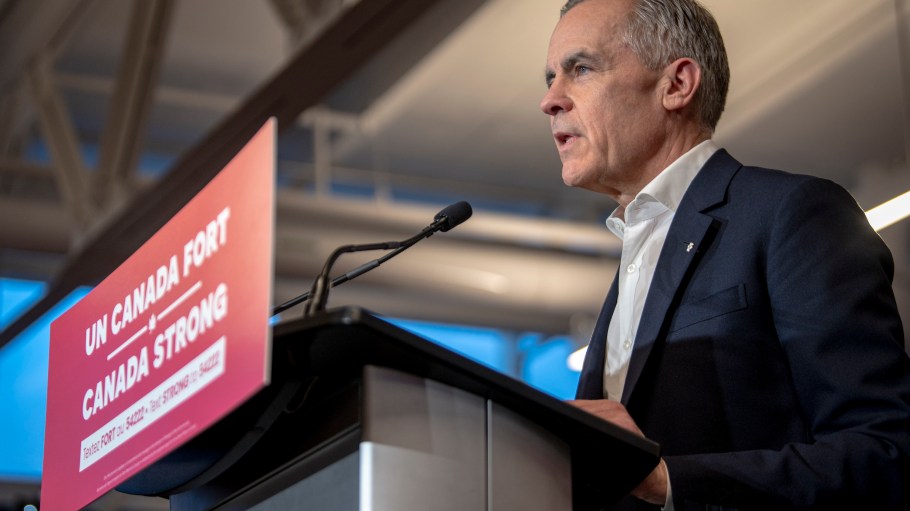
If Canada plans to bolster its economy and reach its goal to double non-U.S. exports, the country needs to put its foot on the gas when it comes to updating its national ports infrastructure, warned Prime Minister Mark Carney.
“We have fallen way behind in terms of the productivity of our ports and our trade corridors as a whole,” said Carney, at an event in Vancouver, Wednesday morning. “The time it takes from a good showing up just off the coast to landing in central Canada or the U.S. is measured in weeks, not days.”
Related Stories
Efficiency has not been Canadian ports’ strong suit. Under the World Bank’s latest assessment of global port performance, released in September, the Port of Vancouver ranked 389th out of 403 in terms of the time container ships spend in a port. Canada’s other major West Coast port, Prince Rupert, did not fare much better at 362nd. The Port of Montreal was ranked 344th.
More recently, Vancouver had the fourth-largest increase in import dwell time worldwide, according to data from container tracking platform Vizion. While dwell times averaged 9.6 days in the period of May 4-10, they jumped 16.3 percent to an 11.2-day average in the May 11-17 week.
The prime minister’s message follows a caution from the Bank of Canada earlier this month that the country’s ports have become less directly connected to global shipping networks than ports in other countries.
Using satellite data from ExactEarth, the bank found that degree centrality—an indicator of the number of unique destinations directly connected to a port—declined significantly across Canada’s five most connected ports between 2016 and 2023.
Additionally, the central bank said the total deadweight tonnage of all vessels departing from or arriving at Canadian ports fell from 167 million metric tons in 2016 to 119 million metric tons in 2023, a decline of 28 percent of maritime trade capacity.
The bank observed that Canadian ports have not adapted to the prevalence of ultra-large container vessels built in recent years, giving them a disadvantage compared to American ports.
“That’s partly port capacity; it’s partly…rail interconnections. It is a variety of factors that are there, and we’re looking to tackle all of those in a comprehensive way,” Carney said, addressing the Greater Vancouver Board of Trade.
Amid the concerns, stakeholders throughout the country have been making port investments. In January, Canada’s Port St. John completed a four-year $178 million modernization project that expanded container terminal capacity from 150,000 20-foot equivalent units (TEUs) to 800,000 TEUs annually. That expansion included a new 1,131-foot berth allowing the port to handle vessels of 10,000 TEUs or larger.
In March, the Canadian government set aside $5 billion Canadian dollars ($3.6 billion) in financing that port authorities and others, can access to expand trade corridors.
Among the first major infrastructure initiatives the Carney administration backed was a $2.3 billion-Canadian-dollar ($1.7 billion) expansion at the Port of Montreal, which, when completed, would increase container handling capacity there by 60 percent.
Last September, the Montreal Port Authority (MPA) and global port terminal operator DP World entered an agreement to expand port facilities at the Contrecoeur Terminal. But that project will take some time, with land-based construction expected to begin in 2027. The terminal is expected to be completed and commissioned by 2030.
On the other side of the country, the Vancouver Fraser Port Authority is also pursuing a project to expand capacity at the Port of Vancouver by 30 percent. The authority, which handles roughly $350 billion ($253 billion) of Canadian trade annually, is awaiting permit authorization from Canada’s fisheries and oceans department.
According to Carney, the Port of Vancouver will run out of capacity within the next decade.
Canada is seeking to address its port capacity and efficiency issues as the country aims to build on its relationships with trade partners.
Last October, in the wake of tensions with the U.S. over tariffs levied on the country’s aluminum, steel and lumber sectors, Canada’s federal government pledged to double non-U.S. exports by 2035, or roughly $220 billion in new orders for Canadian commodities, goods and services.
Prior to 2025, over three-quarters of all Canadian exports were U.S.-bound, and about 20 percent of the country’s economic output was linked to U.S.-Canada trade. Canada is the top export destination for 36 U.S. states, and nearly $3.6 billion Canadian ($2.6 billion) worth of goods and services cross the border daily.