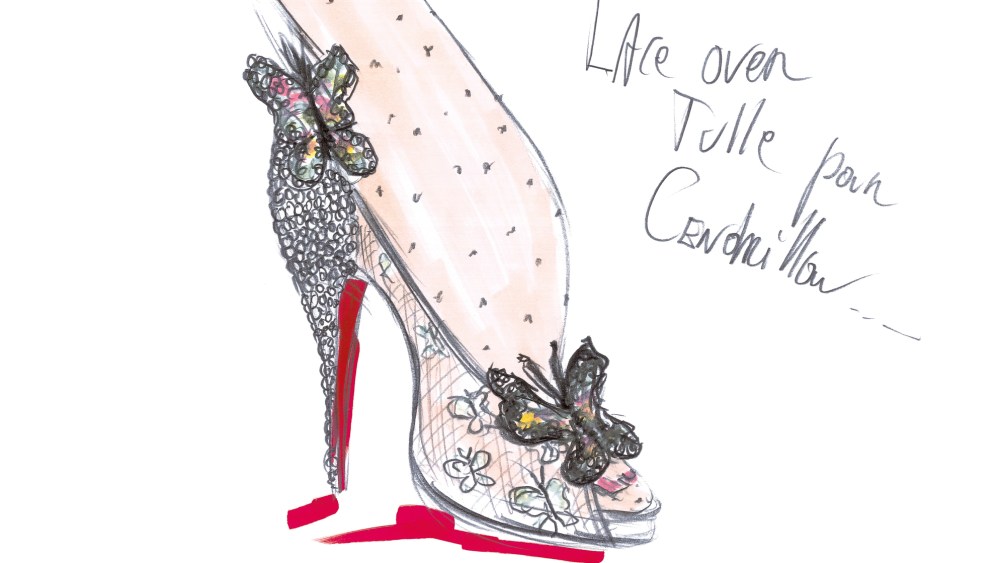
In this “Cinderella” story, the size of the glass slipper is no mystery: A 37, the standard size Christian Louboutin always uses when developing a shoe.
But what a shoe! It was 2012 when Walt Disney commissioned the designer to create an interpretation of the fabled footwear in honor of the rerelease of the classic film on Blu-ray and DVD.
Louboutin reimagined the fairy tale with Guipure lace, leather, crystal butterflies — and his signature red soles.
Related Stories
In an interview with WWD, he reflected on mind-melding with Disney, and the most mythical shoes on the silver screen:
You May Also Like
WWD: What does Disney represent to you, and how does the studio and its storytelling inspire you as a creative person?
Christian Louboutin: I have worked with Disney for many years, and each time it feels very natural. We share something, which is this idea of fantasy and transformation. Their stories are very strong visually, but also emotionally. Each character has its own identity, its own colors, its own materials, almost like a vocabulary. For me, it is always a playful process, but not only playful. It is also very instinctive, because these stories are already part of our imagination. You do not invent them, you enter them, and then you interpret them through your own language, which is beautiful.
WWD: Need we guess your favorite Disney film?
C.L.: “Cinderella,” of course, because the shoe is at the center of the story; it’s quite rare. The shoe is not only something beautiful, it’s what changes everything. I’m always drawn to characters who carry a form of dream or possibility. There is something fragile, but also very strong in that. It is very close to how I see women, and how I design for them.

WWD: Did the slippers you designed come to you in a dream, or in the workshop?
C.L.: It always starts with a sketch, to find the line, and then it becomes a form. But with Cinderella, the idea was already very clear in my mind. Since the beginning, I always had this idea of a “Cinderella shoe.” A shoe that is rare, almost impossible to reproduce, something that could disappear. So in a way, Cinderella was always present in my mind. For this project, there was no ambiguity. Lightness, beauty and transparency were the words that guided me. It was not only about the material, but about the dream she carries: A dream materialized.
WWD: What was the biggest challenge in creating your Cinderella shoe? Do you recall how many hours went into the realization of the design?
C.L.: The challenge was to create something that feels almost immaterial, while still making a real shoe. Of course, being inspired by the glass slipper, it needed lightness, transparency and delicacy, but as a real-life shoe, it also needed structure. Delicate lace adorned with crystals gave the slipper its enchanting look, but the work was in making those details feel weightless. You need technique, but at the same time it should not feel heavy or constructed. It has to remain very fluid, almost like it could disappear. I don’t think it’s about hours, it’s more about arriving at the right balance, the right feeling.
WWD: Why is it important to keep an open mind about creativity and cultural inspiration, and how has America fed your creativity over your career?
C.L.: For me, creativity comes from curiosity. I have always been driven by enthusiasm, freedom and the desire to discover new places, new cultures, new people. Inspiration never stays in one place. For me, it can come from an architectural detail, a color, a film, an attitude, and then it can remain somewhere in the mind before appearing for me in another form. America has a very particular relationship to imagination, especially through film. There is freedom in the way stories are told, a way to mix reality and dream, which I find very inspiring. I feel this very strongly with someone like David Lynch, through his colors, his music, his choice of actors, his emotion and his aesthetic. Whether it is Disney or David Lynch, it is always about entering a universe that is already very powerful and then interpreting it in your own way. I think creativity needs this movement between worlds and cultures, otherwise it’s static.