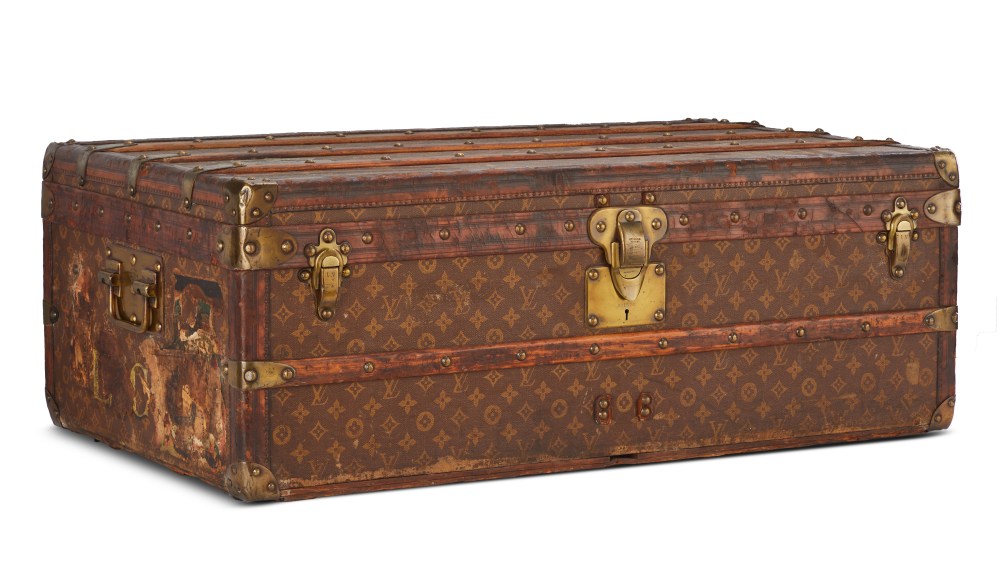
The history of Louis Vuitton’s signature Monogram motif, which celebrates its 130th anniversary this year, is intertwined with the brand’s U.S. presence.
The brand is showcasing two historic pieces as part of Comité Colbert’s “Hidden Treasures, 250 Years of Franco-American Luxury Stories” exhibition in New York City: a cabin trunk acquired by Louis Comfort Tiffany in 1907, and a suitcase from the spring 2001 collection designed by Marc Jacobs, who commissioned American artist Stephen Sprouse to customize the Monogram with graffiti.
Related Articles
Bleue-Marine Massard, head of heritage collections at Louis Vuitton, said the selection was designed to highlight a history stretching back to 1893, when Georges Vuitton first exhibited his wares at the Chicago World’s Fair, spearheading the brand’s overseas expansion.
You May Also Like

“Between the Chicago fair in 1893 and the opening of its first stand-alone U.S. store in 1980, Vuitton established a network of distribution agents across the States including department stores like Wanamaker’s and Saks,” she said.
A WWD report from 1927 describes a Saks display filled with items including a shoe trunk with “an ample lower drawer for riding boots.” From the 1960s, Vuitton collaborated with the retailer on a line of co-branded products developed specifically for the U.S. market.
In a 1968 interview, Gaston-Louis Vuitton — then 86 — recalled the 1920s as a wild and extravagant time, noting that solid gold fittings were commonplace on 50-piece crocodile luggage sets.
“The snob appeal was there from the beginning,” he told WWD, noting that his grandfather Louis Vuitton, the founder of the business, was the personal packer of Empress Eugénie, the wife of Napoleon III. “In those days we made trunks for all the Americans coming to Paris after the Civil War…people like Cornelius Vanderbilt.”
Tiffany, whose father founded Tiffany & Co., may have found in the Monogram an echo of his own Art Nouveau stained glass designs, Massard noted. The house acquired his trunk around the time parent company LVMH Moët Hennessy Louis Vuitton purchased the New York jewelry house in 2020, she said.
Despite Vuitton’s long-standing links with the U.S., LVMH chairman and chief executive officer Bernard Arnault took a gamble in 1997 by appointing Jacobs as the brand’s first creative director of ready-to-wear.
“Marc Jacobs is a designer of rare creativity and unique vision,” Arnault said in a statement earlier this month revealing that LVMH was selling the Marc Jacobs label to WHP Global and G-III. “His impact on the world of fashion is undeniable, and I want to warmly thank him for his contribution to the success of the maison and the LVMH Group over the last 30 years.”
In the interim, Vuitton has doubled down on U.S. creative talent, naming the late Virgil Abloh and performer Pharrell Williams to senior menswear design roles.
Jacobs may have shocked purists with his reinterpretation of the Monogram canvas, but the move was consistent with the DNA of Vuitton, since Georges Vuitton also broke with tradition when he conceived the logo as a way to thwart counterfeiters, Massard argued.
“It’s superimposing layers of history,” she said. “He’s thumbing his nose at tradition, but in a way that pushes the design in a new direction.”