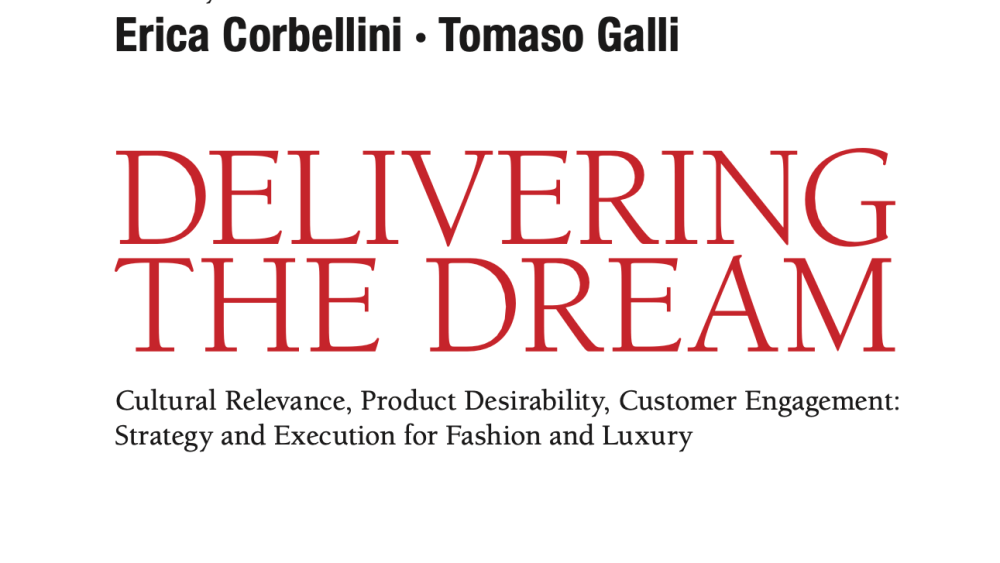
MILAN — The title says it all: “Delivering the Dream,” by Erica Corbellini and Tomaso Galli, is a book “for professionals, students and anyone passionate” about the fashion industry, states former Gucci president and chief executive officer Domenico De Sole in his foreword. “It provides a useful lens to understand not only what leading brands do, but how they make it happen.”
De Sole described the book as “relevant and valuable” because it “reminds us that dreams in fashion and luxury are not abstract: they are built day by day, through the discipline of execution and the alignment between vision and delivery.”
Related Articles
During an interview, Galli said he views De Sole as his mentor, who hired him from PR and marketing communications consultancy Ketchum to head corporate communications at Gucci and taught him “that everything had to be done by yesterday through the power of flawless execution.”
You May Also Like
Galli’s experience as adviser and consultant in marketing and communication was built over 35 years working at Prada after Gucci, then with brands such as Zegna, Thom Browne and Saint Laurent, to name a few.
He collaborated with Corbellini, tenured lecturer at Bocconi University, Department of Management and Technology, for more than two decades. While she pitched the idea of the book as far back as 15 years ago, the two began working on it only last spring. “It was a great collaborative process and we wanted to really use concrete examples and be as practical as possible,” said Galli.
This led to contributions in the book by the likes of Donatella Versace on supermodels and how “they brought the fashion industry to a whole new audience” as they “played a role in popular culture,” she states; Zegna’s artistic director Alessandro Sartori on “designing for a customer-collector’s wardrobe,” and Anthony Vaccarello, creative director of Saint Laurent, on the company’s film production company, how it contributes to “the dialogue between disciplines,” as he writes that fashion “teaches me the discipline of form; cinema teaches me the permanence of narrative.”
Corbellini, who dedicated the book to her students, described it as “useful,” and the manual she “would have liked to read but could not find, delving deep into how things get done, staying away from cookie-cutter formulas.” This is precisely Galli’s own mantra.
“I am allergic to formulas, to toolkits, to whatever works for one company and then becomes the fashion. Firstly, you must understand the context, what kind of company you are in and then you have to devise your own strategy for where you want to go with the resources that are available and the people in the company. What works for a brand doesn’t work for another,” said Galli. “This is really important to me. Repeating formulas is the most boring thing, it kills fashion and it kills brands.”
That segued into a praise of Miuccia Prada and her husband Patrizio Bertelli, who he views as “true leaders. They know there are risks inherently into doing new things, but they continue to want to do new things. It’s important to take risks.”
Working with Galli on the book, Corbellini was impressed to see how “theoretical concepts have been applied to marketing,” and by “fashion’s proximity with culture, mirroring reality without filters. How fashion, art, music and sports are connected worlds and how they are part of the fashion industry.”
It was important, she continued, to underscore how communication is not superficial, “how there is substance behind the visibility and the image.”
Galli’s advice to those approaching marketing and communication is “to be honest with themselves. I always interpreted marketing as a two-way communication, so you should not just be the mouthpiece of a brand, but first and foremost listen to the outside voices, to journalists, activists, the market, to those that can tell you a lot of things which are important. When brands started to want to control the narrative on media, it was killing the media.”

Galli has worked with some of the most talented designers in the industry, including Tom Ford and Miuccia Prada, and he believes that “in a design-driven brand, normally a designer doesn’t want to know what consumers want, but they design for what consumers will want 12 months from that moment.”
He recalled how Ford, when asked about merchandising, would reply: “Listen, I receive the reports. I look at them carefully, then I file them in the bin, and my job starts. Because merchandising tells me what people wanted yesterday. Steve Jobs always said ‘if I had asked what people wanted, I would have never come up with the iPad.'” Pausing, Galli added: “I think Henry Ford said ‘if I had asked consumers, I would have proposed a faster horse, not a car.’”
Working with brands, the C-suite and designers, led him to believe that his job title was “sort of chief consistency officer,” building “bridges between management and the creative talent whenever the vision went into different directions. I don’t like to just come in, give my opinion on the strategy and then goodbye; I try to be part of the implementation.”
In fact, Corbellini said she admires Galli’s understatement, “always wanting to stay behind the scenes, putting himself at the service of the client.” In turn, Galli underscored Corbellini’s “academic take. At the end of the day, I’m a manager, I’m not an intellectual. And Erica really really understands the industry, and she brings a scientific rigor that I don’t have. The balance is interesting and she challenges me, she does things in ways that I would not dare to do; for example, she’s promoting the book on TikTok,” he said with a smile.
To be sure, admitting his lack of knowledge on the subject, he asked Alessio Vannetti, a former Valentino and Gucci chief brand officer who also worked at Prada for years, to write about TikTok in the book, “as he was the first who spoke to me about it when most people didn’t even know what it was,” said Galli. “Same thing for [brand strategist] Richard Bao for the chapter on China. We can deliver a lot more value to our readers through the voice of those who can share their own experience,” including Versace, Vaccarello and Sartori, he mused.
“Fashion is culture and for any marketer who comes from other industries and thinks that we’re just selling another product, that’s the biggest mistake that they can make. This is not another product. This is a very different thing. You’re dealing with meaning, with identity, with belonging and with things that are completely different from other industries. It takes a long time to really understand fashion brands,” Galli concluded.