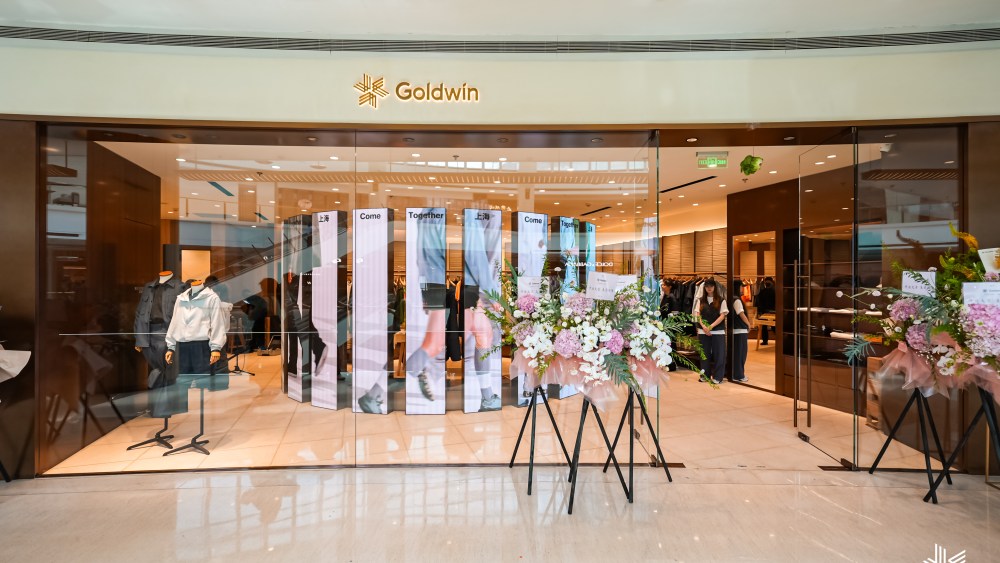
Goldwin‘s latest retail venture has landed at Shanghai‘s landmark luxury shopping mall Plaza 66, occupying a storefront previously split between Bogner and Mulberry.
As Goldwin’s second store along the West Nanjing Road retail artery — its first opened at Kerry Centre down the road — the Plaza 66 unit marks an important step in Goldwin’s push to position itself as an “aspirational luxury” player in sportswear and outdoor.
“We are kind of an accessible luxury brand within sports; we are not purely sporty in feel,” explained Goldwin president Takao Watanabe, who also described the brand’s minimal design as “simple in appearance, almost deceptively so, but with design details that show our understanding of fashion” — which lets the brand occupy a market adjacent to quiet luxury.
You May Also Like
Related Articles
The brand’s proprietary waffle-knit T-shirts, which retail for 900 renminbi, or $132, have become its undisputed bestseller in the Chinese market, a material now synonymous with Goldwin.

“We are relatively confident in — and capable of — taking a leading position in the market when it comes to being the original source of this caliber of material,” said Watanabe, referring to its Tech Lab in Oyabe City, Japan, as the foundation of the brand’s continued technical innovation.
“We know that Plaza 66 customers have a certain expectation of what’s good, not only in fashion design, but also in material design and customer service. If the brand can make it at Plaza 66, we can have confidence for future expansions in China,” Watanabe added.
To celebrate the store opening, the brand unveiled the latest chapter in its “Come Together” campaign. Featuring local talents engaged in light-hearted conversation while walking dogs or grabbing coffee, the visuals appear on the “yashiro,” or ring-shaped LED screens, in the middle of the store, as well as along the corridors of the luxury mall.
Key pieces from Goldwin’s main collection and Goldwin 0 are available in the 1,600-square-foot store.
Goldwin initially entered the Chinese market during COVID-19 with a store at Sanlitun Beijing in 2022, then quickly pivoted in 2024 to form a joint venture with the Suzhou-based Yuanjing Retail Co. Ltd. on retail distribution.
The company currently counts nine stores in China and plans to open six units a year to reach its expansion goals.
“Shanghai is an important market, so are the Beijing, Guangzhou and Shenzhen markets. When we have around five stores in Shanghai, we could consider opening a real flagship, where we can have a different product assortment, some of which are created specifically for Chinese clients. So with a bigger store, we can reach double or even triple the sales of a smaller store format,” Watanabe said.
Measured expansion coupled with a tight merchandising strategy helped the brand restore its China business to profitability for fiscal 2026, which ended March 31. Goldwin expects China sales to grow 32.4 percent annually through 2033.
The brand is also gearing up for expansion in the rest of the world.
This year Goldwin opened flagships in London, New York and Seoul. The Seoul branch is operated by Youngone Corp.
As part of its “Goldwin 500” plan, the brand aims to eventually open around 120 stores globally, with around 70 in China.
“We have a concept called ‘market imagination,’ where you use your vision and experience to imagine new possibilities. We hope to leverage our local partner’s perspective to do just that,” Watanabe added.
Watanabe also views brick-and-mortar stores as information centers where the company can gather intel for brand development. In a similar vein, it launched the Goldwin Field Research Lab a few years ago to complement its technical know-how. As an extension of Goldwin’s marketing team, the interdisciplinary research platform taps into wide-ranging topics such as ideas of homeland, disaster preparedness and animism, all of which could inadvertently translate into fashion and design.
“We may not be a brand like Chanel or Louis Vuitton, but we have a sense of fashion, technical expertise and the ability to develop something from zero to one. Plus, we are both the maker and the seller of the clothes — we are deeply involved in all aspects, rather than just talking about the brand itself,” Watanabe said.
A listed company on the Tokyo Stock Exchange, the Goldwin Group also owns the rights to The North Face in Japan and South Korea, as well as a basket of smaller brands such as Helly Hansen, Woolrich, Per Se and Allbirds.