Updated 3:30 p.m. ET on May 19
PARIS — Chanel’s revenues are increasing in the high-single digits after returning to growth last year, as the company reorganized its teams and bolstered its manufacturing capacity under new creative director Matthieu Blazy.
The French fashion house said full-year revenues rose 3 percent at reported exchange rates to $19.3 billion, representing an increase of 1.8 percent in comparable terms. This marked a turnaround from the previous year, when revenues were down 4.3 percent at comparable rates amid a sharp slowdown in spending in mainland China.
Related Articles
While operating profit rose 5.2 percent to $4.7 billion, net income fell 14.3 percent to $2.9 billion in 2025.
You May Also Like
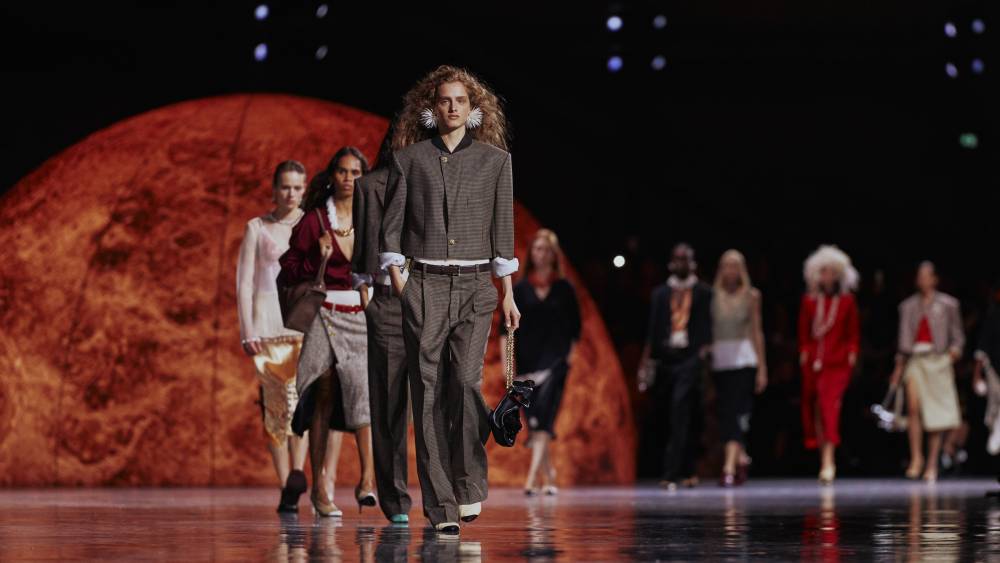
Blazy presented a critically acclaimed first collection in October, but the annual results did not reflect the “Chanelmania” that greeted the arrival of the products in stores in March 2026.
Last year’s advance was fueled by a 7.2 percent rise in organic sales in the Americas. Europe grew 2.5 percent, driven by France, Italy and Spain, while revenue was down 0.8 percent in the Asia-Pacific region, despite improving trends in some countries such as South Korea and Japan — indicating the Chinese market remains anemic.
In an interview with WWD, Chanel global chief executive officer Leena Nair and chief financial officer Philippe Blondiaux said they saw growing momentum across all divisions starting in the second half of 2025 and continuing into 2026, which translated into revenue growth in the high-single digits.
“We are on track and confident for the year ahead and beyond,” Nair said.
Describing Blazy as “one of the most talented designers in the world,” she credited him with breathing new energy into the brand. Chanel topped the Lyst index in the first quarter, after the platform updated its methodology to offer a more comprehensive measure of brand heat.
“It’s been such a joy to see this excitement. The early indicators are great,” Nair said. “There’s a lot of excitement among loyal clients, new clients, people who are rediscovering their love for the brand, so all that is really good to see.”
Sustained Investment
However, she cautioned that Chanel, which is owned by the secretive Wertheimer family, is maintaining the long view. “We are a 110-year-old brand. We try not to be too distracted by the hype or frenzy and stay focused on the long-term strength and desirability of our brand,” Nair said.
“We’re seeing client traffic up, we see client excitement up, we see staff excitement up, we see engagement into the collections a lot more, but we’re always focused on the level of craftsmanship, the quality of execution, the quality of our products, and to take the time it takes to design and produce pieces without compromise, and this naturally sets the rhythm for us,” she explained.
In a recent interview with WWD, Bruno Pavlovsky, president of fashion and president of Chanel SAS, said the company was wary of overproduction, instead targeting reported growth of between 5 percent and 7 percent per year, with price and volume contributing evenly to the mix. The brand raised prices in April by an average of 3 percent.
Chanel’s performance last year placed it ahead of sector peers including LVMH Moët Hennessy Louis Vuitton, whose revenues fell 1 percent in organic terms to 80.80 billion euros, and Kering, which reported a 10 percent drop to 14.68 billion euros. But it trails Hermès, where sales at constant exchange rates were up 8.9 percent to 16 billion euros.
In line with other leading luxury players, Chanel weathered tough market conditions by tightening its belt in 2025. It reduced capital expenditure by 17 percent to $1.45 billion and trimmed its workforce to 38,000 people from 38,400 the previous year. However, stripping out the effect of real estate acquisitions, capex was up 6 percent, Blondiaux noted.
He touted the company’s decision to keep investing in 2024 and 2025 “in a totally counter-cyclical way” despite macroeconomic turmoil that saw luxury spending contract for the first time in 15 years, excluding the coronavirus pandemic.
Chanel plugged $700 million into its manufacturing network, bringing the total number of suppliers it controls close to 75 as it continued to secure access to high-quality materials and vertically integrate its supply chain, he said.

In 2025, it acquired majority control of leather goods manufacturer Renato Corti and bought a minority stake in Como-based silk specialist Mantero Seta SpA, as well as a participation in Scottish cashmere spinner Todd & Duncan, Blondiaux said.
Other key investments included a new fragrance manufacturing facility in France and Nevold, an independent business-to-business hub dedicated to circular material development. The company is also building new global headquarters in London, set to be inaugurated by the end of this year.
New Boutiques
As reported, the Chanel design studio has undergone its most wide-ranging reorganization since Karl Lagerfeld took the creative reins in 1983.
Where previously a single studio churned out 10 collections a year, the house has hired an additional 30 people and created three dedicated teams: one for haute couture, one for ready-to-wear and one for Métiers d’Art and cruise.
“What we have to do as managers is to offer the best possible condition for creators to create, to flourish and to be at their best,” Blondiaux said.
Chanel also continued to grow its store network with the addition of 41 locations, including 26 dedicated fragrance and beauty boutiques, seven fashion stores and eight watch and jewelry units.
Major openings included the renovation of its landmark store at Shanghai’s Plaza 66 mall, which almost doubled in size, and other boutiques in Hong Kong, Las Vegas, Toronto and Fukuoka, Japan.
The house plans to open 30 boutiques in 2026, of which nine in fashion, 16 in fragrance and beauty and five in watches and jewelry, Nair said.
“We are committed to creating the ultimate experience for our clients, from the most loyal to those discovering Chanel for the first time. We know that boutiques are really, really important as a touchpoint: 50 percent of the reason a client engages with Chanel, discovers Chanel, becomes part of the Chanel family is because of the relationship with the fashion adviser and boutique adviser,” she said.
Chanel is also selectively expanding e-commerce in the beauty segment. In tandem with the rollout last year of Chance Eau Splendide, its first new women’s fragrance in eight years, it introduced a new fragrance and beauty app and launched online retail in Mexico and Argentina.