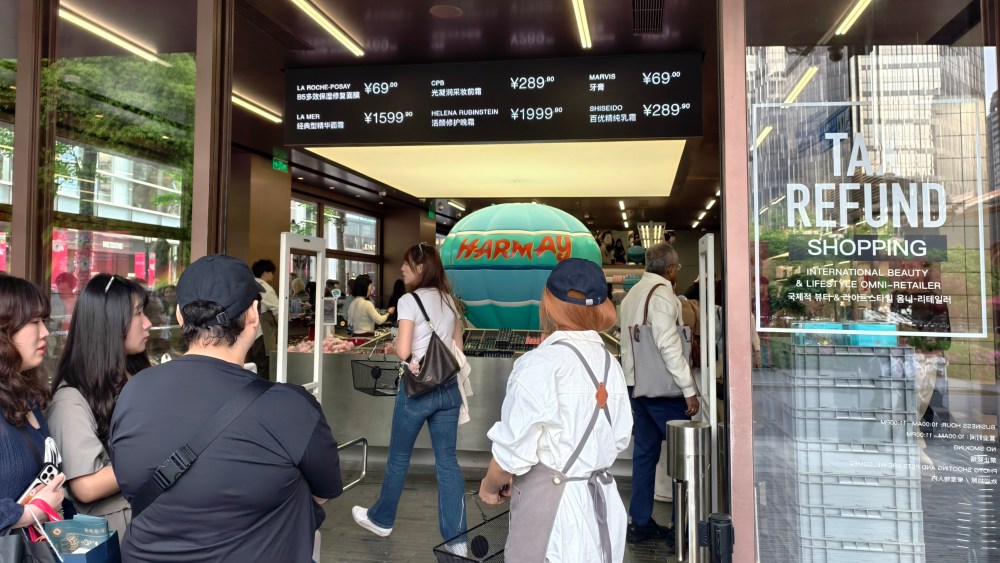
Betting on travel and tourism to boost the local economy, China‘s Ministry of Commerce recently issued a series of regulatory updates that could further unleash international spending power.
In the policy update, two details drew particular online attention — a “refund-upon-purchase” procedure will allow travelers to receive a tax refund at a port of exit outside the place of purchase, while the deadline for the procedure has been extended to 28 days nationwide.
The policy update, an answer to a nationwide “Shop in China” campaign, meant that from July 1, a visitor who lands in Beijing will be able to receive their tax refund in Shanghai, rather than being required to complete the process in Beijing.
You May Also Like
Related Articles
The 28-day window also brings the country more in line with global duty-free standards. The European Union requires goods to be taken out of the country within three months of purchase; Japan offers tax refunds within 90 days for foreign visitors on short-term visas; and South Korea operates under a similar framework.
Under the “refund-upon-purchase” scheme, which was introduced in April 2025, travelers can receive immediate cash refunds — ranging from 9 percent to 11 percent of the ticket price — in stores or at designated shopping malls.
At the same time, the minimum spend was reduced from 500 renminbi, or $73, to 200 renminbi, or $29, per store per day, while the daily refund cap increased to 20,000 renminbi, or $2,940.
As a result, tax refund sales doubled year-over-year in 2025, while the number of travelers completing refunds tripled. The number of tax refund stores quadrupled during the same period to around 13,000 nationwide, according to data from the Ministry of Commerce.
“China had been largely opaque to Western tourism for decades, not because there was nothing to see, but because the infrastructure — including visa, payment, perception — made it feel inaccessible. All three started shifting at once, and user-generated-content filled the information vacuum almost instantly. That feedback loop is still accelerating,” said Maria Laura Corneti, a consultant at the Shanghai-based Daxue Consulting.
Beijing and Shanghai remain the most popular travel destinations for foreign nationals, receiving 454,920 and 670,900 foreign tourists, respectively, in April — returning to pre-COVID-19 levels, according to data cited by Xinhua News, a state-owned media agency.
“Foreigners are absolutely everywhere,” proclaimed Wang Qiyang, director of the Dapuqiao subdistrict within Shanghai’s Huangpu District, adding that a density of cultural offerings and a sense of safety continue to drive inbound tourism in the city.
“With the current 240-hour visa-free policy, a lot of foreign visitors coming to Shanghai typically spend around two to three days in the city, hitting a few standard stops — the Bund, Nanjing Road, Yu Garden, Xintiandi, Tianzifang, and the former site of the Provisional Government of the Republic of Korea. These are the spots being recommended on overseas travel websites, by their own travel influencers, and in the tourist guides handed out at international hotels,” Wang explained.
The appeal of Shanghai is particularly accessible to South Korean shoppers, which is only an 1.5 hour’s flight away.
In a recent vlog posted on YouTube, K-pop star Jeon Somi documents a leisurely day trip from Seoul to Shanghai that takes in several retail stops and food outings — including Shushu/Tong‘s Shanghai flagship, one of Labelhood’s five stores in the same neighborhood, and Prada Rongzhai — alongside local staples including xiaolongbao and beef skewers, punctuated by walks through downtown pocket parks.
For Corneti, with e-commerce covering basic functional needs, local physical retail has evolved — at hyper speed — into “centers for social life that integrate wellness, high-end dining, and cultural spaces directly within the urban fabric,” Corneti wrote in a LinkedIn post.
“There’s something I think is genuinely underappreciated in how people write about Shanghai’s retail scene, which is that the expat community, local Chinese residents, and inbound tourists are essentially navigating three completely different versions of the city. We share the same streets but inhabit entirely separate maps,” explained Corneti.
“Local Chinese residents — at least the urban digitally native demographic — seldomly shop in physical stores for everyday needs, going to a store, such as Gentle Monster’s flagship or the Tamburins store, is a deliberate experiential choice, not a default,” Corneti continued.
“The spots that matter most to the expat community are often not fashion retail at all — they’re lifestyle infrastructure, places that function as community hubs,” said Corneti.
“None of that is fashion retail in the conventional sense, but it’s part of the same story — what Shanghai’s commercial and lifestyle infrastructure actually offers the international visitor and local residents,” said Corneti, who said that “15-minute community life circles” created by local policy meant that shopping malls can become an integral part of neighborhood living.
That vision is playing out most visibly along Shanghai’s Huaihai Middle Road. Home to flagships such as Gentle Monster, Songmont and DKNY, the strip has become a magnet for foreign travelers, who have likened its energy to that of Seoul’s Seongsu-dong. The comparison has stuck — and the foot traffic has followed, spilling into the pockets of neighboring streets being quietly revitalized by the same wave of inbound visitors.
“We have witnessed a remarkable surge in overseas tourist foot traffic recently,” said Sherry Huang, founder of the multibrand retailer ENG, which just launched an expanded storefront at Huaihai Middle Road’s TX Huaihai retail complex.

“We’ve noticed that homegrown Chinese brands are gaining great popularity among international shoppers, which perfectly showcases the outstanding influence of Chinese cultural exports,” Huang added. “This market trend will exert a moderate impact on our overall merchandise sourcing strategy.”
ENG’s next door neighbors have found themselves on the receiving end of the same quiet renaissance.
Pane, the Shanghainese footwear brand known for its 800 renminbi, or $117, sneakers; Muva, the Guangzhou-based leather goods label with a large Southeast Asian following; and Songmont, the Beijing handbag brand, have all seen a notable uptick in international shoppers along Huaihai.
At Pane — whose leather sneakers read as a hybrid between vintage Nike Moon Shoes and Maison Margiela Derby shoes — international shoppers account for 30 to 40 percent of customers at its Huaihai address, which opened in January, while other locations, including those in Shenzhen and elsewhere in Shanghai, capture around 20 percent.
The brand, launched in 2022 by five local creatives, adopts a global visual language through Greek god motifs and counts around 130,000 followers on Instagram. It has developed a significant following in Russia and Southeast Asia and is planning to open its first international store in Bangkok later this year.
Songmont, which expresses “a local sensibility and something that would look at home in any European city,” based on Corneti’s observation, said the brand’s inbound tourist foot traffic and purchase volumes have consistently been high — partly because its overseas retail prices run approximately 1.4 times higher than its domestic prices, making purchases in China more attractive to foreign shoppers. A similar dynamic is at play at Pane, where global prices run around 45 percent above domestic ones.
Nice Rice, another Huaihai Middle Road tenant known for minimal apparel, also noted a growing foreign clientele motivated to “buy a little more” by the streamlined tax refund process. Customers claiming refunds now account for 20 to 30 percent of total visitors at its stores, the brand said in a local media report.
Under the current top-down mandate to court foreign visitors, where have local shoppers gone?
According to recent research from Bernstein, “far more price aware” Chinese consumers are increasingly turning to factory outlets and secondhand platforms, while gravitating toward “well-positioned Chinese brands that offer better perceived value at lower absolute price points.”
”There’s something happening with Chinese consumers that I’d describe as a move toward meaning over markers,” explained Corneti.
“Consumers are looking for authenticity in a way that’s new for this market. It maps directly onto the quiet luxury shift — Dior pulling back on logo visibility isn’t accidental, it’s a response to a real change in what signals taste to this consumer. The person who knows, knows. That’s become the aspiration,” added Corneti.