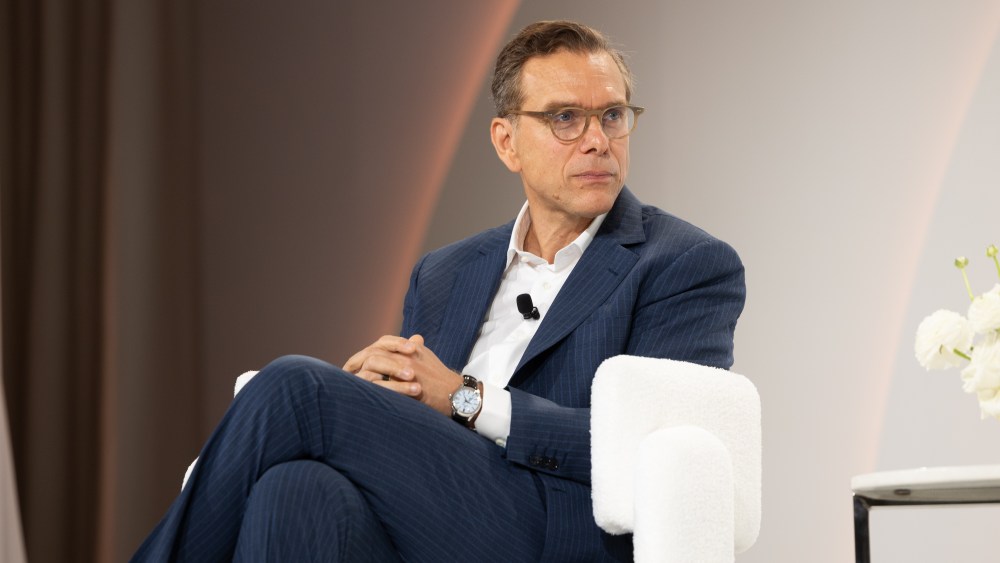
One-hundred days in and not a minute wasted.
Alexis Perakis-Valat, chief executive officer of L’Oréal USA, has hit the ground running in parent company L’Oréal’s biggest market — and also hit the road.
“I’ve been on shop floors, on plant floors, I’ve talked to a lot of our employees, and I’ve had tons of meetings with our teams and with retail partners, which is absolutely fascinating,” Perakis-Valat said in conversation with Jenny B. Fine, WWD executive editor, beauty and editor in chief of Beauty Inc. “After 32 years at L’Oréal, I keep learning and discovering so many new things, and the first observation is that L’Oréal in the U.S. is both a concentration of what L’Oréal does at its best and at the same time, a demonstration of our ability to adapt to the specificities of a market.”
Related Articles

The beauty giant markets more than 35 brands in the U.S., and a touch less than half of the business is done with American brands. “The other half is done with French brands, Italian brands and, maybe one day, Korean brands. That’s what we like at L’Oréal — to be able to portray this diversity [in geographies], and also in prices. We were super happy to have Kering Beauté and Creed join our family and we’re equally happy to be able to offer home hair color for less than $5 under the Garnier brand.”
L’Oréal holds 14 percent market share in the U.S., and thinking of the company as an underdog is what pushes Perakis-Valat to keep driving gains. “We are thinking like challengers, we hate complacency, we don’t want to be arrogant, and we don’t want to give advice to amazingly creative people,” he said. “What is also interesting is that what we did in this country is adapt to the specificities of the U.S.”
Case in point, SalonCentric was born out of a U.S.-specific need to optimize the ever-fragmented professional hair care channel. “Now we have 800 stores across the country for stylists and it gives us this contact with the professionals that shape our industry,” Perakis-Valat said. “It gives us a lot of insight, and it’s a great example of how you can create new things that are not in the current playbook to adapt to a situation.”
As he’s thinking about the integrations of AI at L’Oréal USA, Perakis-Valat is also drawing upon past digital revolutions he’s been a part of. The e-commerce revolution in China in 2010, when he was leading that geography, “was like riding a dragon,” he said. “It was exactly the moment when e-commerce exploded, and it was fascinating. Two things I took away is the human adventure, because you have to make HR decisions not based on experience or job titles but on skills. We had no seasoned e-commerce experts in the market, so you couldn’t put a job offer. You had to look in your own teams.”
In terms of AI, the CEO is thinking of the company’s integration efforts in three chapters. “Chapter one is really AI-powered consumer journeys, so it’s what lots of people have talked about. We launched a beauty assistant, we’ve learned a lot, and that’s a very big part of the effort,” Perakis-Valat said. “Chapter two is AI-powered functions, we call them ‘metiers’ because we like to add a French twist, so it’s about how we empower our marketing teams and we see tons of opportunities in R&D — our ability to test new molecules at speed, that scale will accelerate the quality and the speed of innovation, and then the third chapter is AI-powered employees.”
The company has internal competitions with LLM-agnostic tools as well. “Change is a part of our culture and our DNA,” Perakis-Valat said. Prior to helming L’Oréal USA, he was globally running the company’s Consumer Products division, which includes L’Oréal Paris, Garnier, Maybelline New York and more.
“What we did is focus a lot on innovation, we focused on new markets. We worked a lot on emerging markets, and I went to Indonesia, Brazil and Latin America. It’s a part of my job I love, because I love discovering new cultures, and it’s about discovering how cultural beauty is,” he said. “I tried to assemble a team that was reflective of the diversity of our consumers, so we had a team that was very, very diverse.”
As befitting someone who was born in Greece and then moved to France as a boy, Perakis-Valat’s approach to beauty is democratic. As an example, he cited the mission he developed for the Consumer Products division, “to really bring the best of beauty to more than 1 billion people around the world. That’s very motivating,” he said. “We also try to do it in the most respectful way for the planet, and one of the things we did as a team is all our shampoos around the world are all made of recycled plastic, 100 percent.”
Perakis-Valat didn’t initially plan on going into beauty, but did discover his affinity for the industry pretty quickly. “What I love about beauty is that it’s changing over time, it’s a true blend of emotions and rational thinking, of desire and functionality, of left-brain, right-brain and also magic,” he said. “This blend is absolutely amazing, and, of course, the fact that it’s a force for good.”