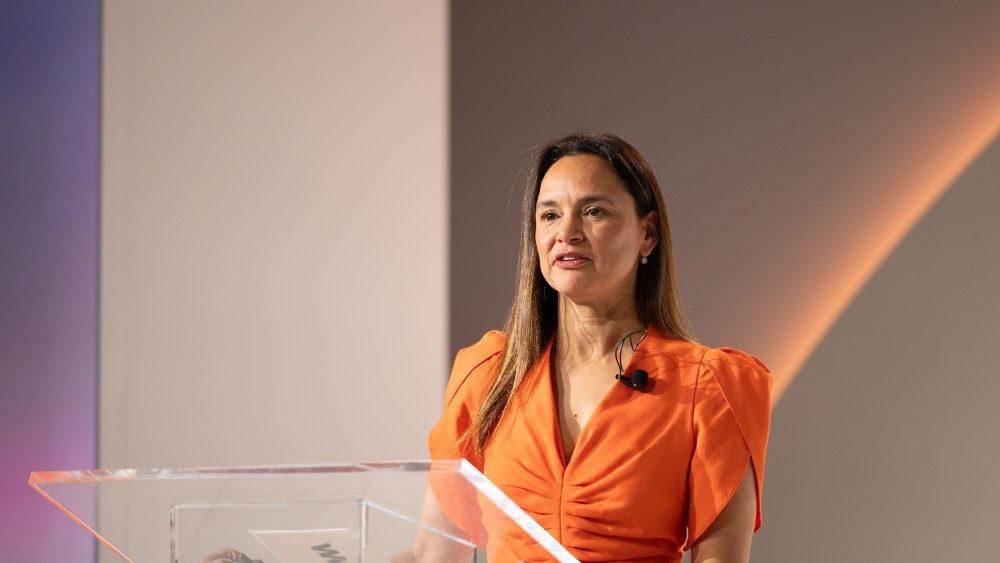
Just how are public and private market investors thinking about the consumer sector?
That’s the question Jeannette Smits van Oyen, the global head of global consumer and retail investment banking at JP Morgan, set out to answer during her presentation at the 2026 WWD Beauty CEO Summit.
“Some companies are being very richly rewarded, and that’s priced in, and others less so,” she said.
Beginning with the data, she pointed to the fact that in 1996, there were more than 8,000 listed companies in the U.S., and today that number is half. As well, the average corporate lifespan of an S&P 500 company was 33 years, and now it’s 15, but the weight to the top companies has more than doubled.
Related Articles

The same is true in consumer retail: There are 20 percent fewer consumer companies and 30 percent less retail companies versus a decade ago. But the share that those companies have control over has gone up exponentially, roughly by a third in the case of consumer and between 50 percent and 60 percent in retail.
Smits van Oyen posited that these statistics help explain the steep increase in large-scale M&A across the board in the last 12 months, citing deals including Keurig Dr Pepper and JDE Peet’s, Mars and Kellanova, Sysco and Jetro, and McCormick & Company and Unilever.
“This is not about synergies, but it is about buying a way into future relevance and future-proofing businesses,” she said. “Across the consumer retail sector, in addition to the large deals, M&A continues to be critical to build out niche capabilities and access to customers.”
Smits van Oyen outlined four shifts in consumer behavior that are driving M&A. First, building out portfolio capability. “If you take the beverage sector as an example, Danone in France recently bought Huel, which is a ready-to-drink sustenance product available widely in gyms so it gives them access into that capability. Similarly, in the U.S., Pepsi buying Poppi gave them access to a different beverage offering than they had developed organically.”
The other three areas to consider are channel perspective, which she believes beauty has in some ways led the way; geography, and demographics.
“Beauty is very much the case study for this” said, referring to acquisitions that help companies expand their channel range. Examples outside of beauty include Deckers’ acquisition of Hoka and eBay’s of Depop, enabling them to “gain access to customers that may not otherwise necessarily find their way to their platform,” she said.
“If we use that framework to then think about the M&A that we’ve seen in the global personal care and beauty market in the last 12 months, I think it fits pretty neatly. In the scale category, Kimberly-Clark acquiring Kenvue, that deal will close, all going well, in the next few months. And a very interesting case study in thinking about the life cycle of a consumer, from baby to older, through various stages in life, and a complementary portfolio across different products and categories. And then, of course, the L’Oréal-Kering transaction.”
She also cited Henkel’s acquisition of Olaplex and Not Your Mother’s, Unilever’s acquisition of Grüns and Minimalist in India, and E.l.f.’s acquisition of Rhode to highlight how companies are using acquisitions for channel, geographic and demographic mix.
Smits van Oyen left the audience with five key questions to ponder: “If we think about portfolio, how much of next year’s revenues are going to come from products that didn’t exist five years ago? From a channel perspective, are we showing up where our customers actually shop? Geographically, and this ebbs and flows, but are we driving local leadership or are we maintaining a global presence?” she asked. “And from a demographic perspective, are we building brand relevance across cohorts or are we just building awareness? Central to it all is this notion of are we building scale and are we doing that by building and growing the company or are we buying it?”