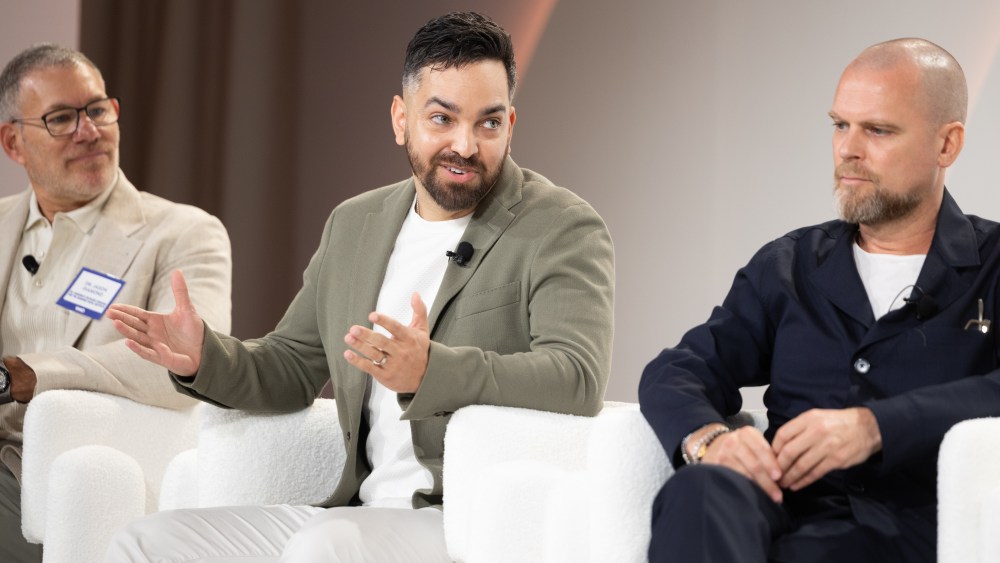
The convergence of services, science and longevity is changing the face of skin care, according to dermatologist Dr. Muneed Shah, plastic surgeon Dr. Jason Diamond and Jean-Guillaume Trottier, chief executive officer of Biologique Recherche, who were in conversation with WWD beauty and fashion market editor James Manso at the Beauty CEO Summit.
Shah, a board-certified dermatologist and founder of Remedy skin care, noted a direct correlation between what he is seeing online — on YouTube, Instagram and TikTok — and in his office, almost simultaneously.
Related Articles

For example, when celebrities were getting their hyaluronic fillers dissolved, none of his patients wanted to get fillers that week, for instance. As well, as the use of GLP-1s has increased, more patients were arriving in his office with skin concerns related to rapid weight loss.
“We have to know what’s happening on social media in order to navigate that,” Shah said.
While some things change, others remain the same. “People want to look great,” said Diamond, Beverly Hills double board-certified plastic surgeon and founder of Dr. Diamond’s Metacine Skincare. “End of story.”
Biologique Recherche, a skin care and institute brand, also works closely with aesthetic doctors pre- and post-procedure, focusing on the likes of skin quality and barrier. Such doctors collaborate with Biologique Recherce’s research-and-development director, who is given access to clinical information.
“That’s really personal collaboration,” Trottier said. “When running our business, we clearly leverage personalized skin care, because we were born with personalization. But that’s a different approach of service.”
The brand has its own treatment protocol with unique gestures, which are developed by education and R&D executives.
Shah does not sell Remedy products from his office. Information on it is shared there, as is some sampling. “We’re a pure-play, masstige dermocosmetic brand,” he said. “Every product starts with a patient concern. So by the time our marketing team sees the product, it’s already finished.”
Shah called his office “the ground floor.” He said: “You can feel the pulse of what’s happening in the world.” When gas prices rise prior to a jobs report coming out showing losses, Shah notes changes in spending. His patients range from Medicaid recipients to those with lots of disposable income.
“The office is really relevant to our brand, informing what we make next and how to make it better,” Shah said.
Diamond’s office is also his lab. “For us, every single product in Dr. Diamond’s Metacine is based on, tied to and inspired by something that I’ve done, either in the operating room or in the office with medical-based and nonsurgical procedures,” he said, citing his Instafacial Collection that is based on his use of people’s own stem cells and nano-fat in surgery as an example.
Now, people from around the world using the products have come into his office asking for the treatments from which the products were inspired. “We knew that the office would impact Dr. Diamond’s Metacine, but we never thought Dr. Diamond’s Metacine would impact the office,” Diamond said. “We’ve seen that. It’s a testament to how you can leverage both your services and your products to really deliver you brand’s message and purpose.”
The trio also discussed other cutting-edge therapies that could have a similar wide-reaching impact as GLP-1s. “Peptides are huge,” Shah said, noting U.S. health and human services secretary Robert F. Kennedy Jr. announced the start of green-lighting and fast-tracking injectable peptides. “This right now is fringe, in a way.”
Shah said a subset of patients are asking about the likes of BPC-157s and GHC copper peptide injections, which are about to become relatively mainstream.
“We need to be prepared as physicians for what that’s going to mean for our patients as they seek them out, and whether or not these are going to be safe and effective,” Shah said. “Out of Asia, we see PDRN injections are very popular. It’s coming into skin care, but it’s still not legal in the U.S. to inject PDRM.”
People are traveling to South Korea for such treatments today.
“We live in this global economy, social media economy, where everyone’s consuming the same things,” Shah said. “They’re coming into the office and seeking these things out. We need to be informed about what they are and when we’re ready to integrate them safely. We should be either first movers or the ones having the dialog around the guardrails.”
Diamond agreed, saying it’s key to understand how what the FDA approves will affect patients’ physiology — like “Ozempic face,” which results from weight loss due to GLP-1s. He’s done facelifts on 28 women who each have lost 100 pounds.
Trottier also has been seeing the effects of GLP-1 on skin. A young woman might have the skin concerns of an old person. “So that’s what we are trying to address,” he said. “We are creating different services and protocols to work on the long-term.”
In terms of R&D, exploring the unknown to be disruptive is key for Biologique Recherche. “We are fast-tracking a lot of tests by using AI,” Trottier said, adding that AI is never the starting point of the brand’s innovation, however.
Shah noted patients are seeking to enhance the basic skin care routine they already have. “So we’re forced, as content creators and dermatologists, to both make better products, but also make content that’s a bit more advanced for our audience,” he said. Shah believes people are looking for a bridge between in-office treatments and topical skin care, too.
“Devices are becoming a huge category,” he said. “In the skin care world, we’re seeing a lot of inbound from external markets. Korean market is huge. Indonesian market is starting to penetrate. J-beauty is back in a big way.
Trottier noted how “skintellectuals” — or highly informed skin care consumers — are also changing the face of skin care. The rising generation, formerly obsessed with fast treatments giving immediate physical results, now understands that a long-term routine is much more effective than a quick shot of any product, he believes.