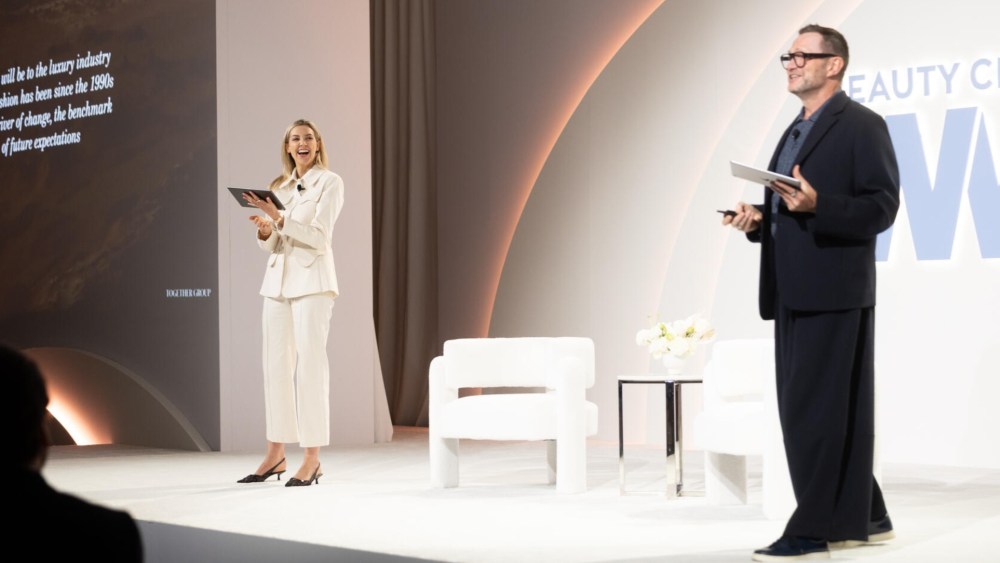
“Today, with all of these rapid advances that we’re seeing in technology, and especially AI, we have to ask, do these old categories [beauty, fashion and wellness] and the boundaries that they represent even exist anymore?”
Such was the question posed by Chris Sanderson, cofounder of The Future Laboratory, in conversation with Madeleine Boyd, global senior vice president of beauty and wellness at the Together Group, at the 2026 Beauty CEO Summit.
“In theory, technology was supposed to diversify beauty. In reality, it’s often doing the opposite. Now, if machines interpret beauty for us, do we really trust those judgments? And what happens to the brands that follow their lead?” Sanderson continued.
Related Articles

According to Sanderson’s research, 49 percent of 18- to 35-year-olds are “comfortable with AI communication from brands.” But only 24 percent of 18- to 24-year-olds trust it. This means that “brands, in their rush to innovate with AI, walk a precarious line between progress and the risk of eroding the very trust that they need to survive,” Sanderson said.
So, how can brands maximize the efficiency of AI and evade the risks involved? To answer this, Sanderson and Boyd examined three rising trends they named algorithmic amplification, creator verse and mood curation, in what they described as the “artifical era.”
Addressing the algorithmic amplification first, Sanderson likened modern digital spaces — TikTok, Instagram, Spotify, Netflix and more — to echo chambers, systems that prioritize familiarity over diversity. “They’re designed to give you more of what you already like. The result is content that feels safe, recognizable, and increasingly emotionally hollow,” he said.
When brands tap into this homogenized, overtly manufactured content, audiences begin to question the authenticity. Boyd cited Dove as a leader in the rebellion, actively fighting against the unrealistic standards of beauty associated with the use of AI-generated images today.
But it’s not just images; AI creators are boasting the same aesthetic norms, too. “Algorithms and AI are shaking up what it means to be authentic and who owns the audience and how influence is built or lost,” Sanderson said.
“It’s also making creator context more complicated. Deep fakes, synthetic content and algorithmically optimized output blur the line between what a creator produces and what is generated by AI, raising new questions around ownership, authenticity and also trust. In this landscape, co-creation, transparency and careful attribution are emerging as the keys to preserving genuine influence,” Sanderson said.
Brands now bear the responsibility of identifying those in control of its creative assets. They “must be transparent about how AI shapes content, framing it as a collaborator rather than a replacement,” he continued. “Audiences will accept the artificial, but they will reject the inauthentic.”
While AI can’t replicate the sensorial satisfaction of real-life experiences, if used properly, it can amplify in-person activations.
“Beauty today is everywhere, and yet it risks losing relevance. Beauty has become predictable, and predictable is powerless,” Sanderson said, to which Boyd added: “And that tension is exactly where opportunity lives.”